
Byline: By Shahzaib Saqib — The Changer
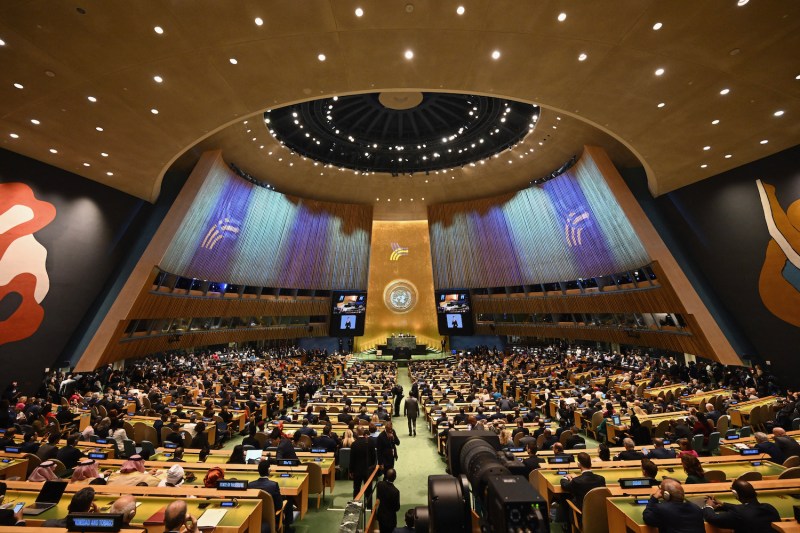
UNITED NATIONS, New York, Sept 8 — The 81st session of the United Nations General Assembly opens in New York on Tuesday under Bangladesh’s Khalilur Rahman, beginning what would ordinarily be another annual cycle of speeches, resolutions and diplomacy. This session, however, carries an unusual institutional weight: Rahman will preside over the Assembly during a year in which the United Nations must confront not only wars, climate and development setbacks, but also the selection of the person who will lead the organisation after Secretary-General António Guterres leaves office.
The 193-member General Assembly formally opens its 81st session at 3 p.m. New York time on September 8, following the closure of the 80th session earlier in the day. Rahman succeeds Germany’s Annalena Baerbock and will serve until September 7, 2027.


His presidency carries the theme “Restoring Trust, Managing Transformation: A United Nations That Delivers for All,” language that reflects a problem deeper than the Assembly’s crowded agenda. Rahman himself warned after his election in June that confidence in the UN was being tested by continuing conflicts, fragile development gains, human-rights setbacks, shrinking humanitarian space and financial pressure on the organisation.
Rahman enters the presidency with six broad priorities covering peace and security, sustainable development, climate and environmental protection, human rights, emerging technologies including artificial intelligence, and UN reform. He has portrayed himself as a bridge-builder who will seek consensus at a time when divisions among major powers have increasingly complicated collective action.
His election itself demonstrated some of those divisions. The presidency rotates among the UN’s regional groups and the 81st session belongs to the Asia-Pacific Group, but Rahman did not take the office through an uncontested regional nomination. In a secret ballot on June 2, the Bangladeshi foreign minister defeated Cyprus’s Andreas Kakouris by 99 votes to 91, with 190 ballots cast.
The result also gives Bangladesh one of its most prominent multilateral positions in decades. Rahman becomes the second Bangladeshi to preside over the General Assembly, following Humayun Rashid Choudhury, who held the presidency of its 41st session in 1986-87.
Yet the most consequential responsibility awaiting the Assembly during Rahman’s presidency may have little to do with the ceremonial visibility of high-level week.
Guterres’s second term ends on December 31, 2026. The process for choosing his successor therefore overlaps directly with Rahman’s presidency. The Security Council recommends a candidate, but the General Assembly appoints the Secretary-General, placing the Assembly at the centre of one of the UN system’s most politically sensitive leadership transitions. The UN itself highlighted the coming succession process when Rahman was elected.
That gives new meaning to Rahman’s promise to rebuild trust and create space for good-faith negotiation. The coming months will test whether the General Assembly can exert meaningful political influence during a period when disagreements among powerful states increasingly shape the UN’s ability to respond to international crises.
Before that leadership transition dominates the diplomatic calendar, the immediate focus will shift to High-level Week, running from September 18 to 28. The General Debate — when presidents, prime ministers and other senior representatives address the Assembly — is scheduled for September 22-28, meaning Tuesday’s opening should not be confused with the arrival of the main wave of world leaders later this month.
The high-level programme also provides an early indication of the issues competing for diplomatic attention. An SDG Moment is scheduled for September 18, followed during high-level week by meetings addressing climate action and a just transition, the 40th anniversary of the Declaration on the Right to Development, sea-level rise, pandemic prevention and preparedness, the Durban Declaration and Programme of Action, and nuclear disarmament.
Those meetings connect directly with Rahman’s own agenda. His vision places sustainable development and climate resilience alongside traditional peace and security questions, while also identifying artificial intelligence and emerging technologies as issues requiring stronger international governance. Bangladesh’s long involvement in UN peacekeeping is another component of his platform; Rahman has pledged to promote discussions on making peacekeeping more effective and sustainable.
But the institutional backdrop makes UNGA 81 different.
The General Assembly remains the only principal UN body in which all 193 member states have an equal vote, yet many of its resolutions are not legally binding. Its influence therefore depends heavily on coalition-building, political legitimacy and the ability of member states to turn negotiated language into action.