
By Haris Saleem — The Changer
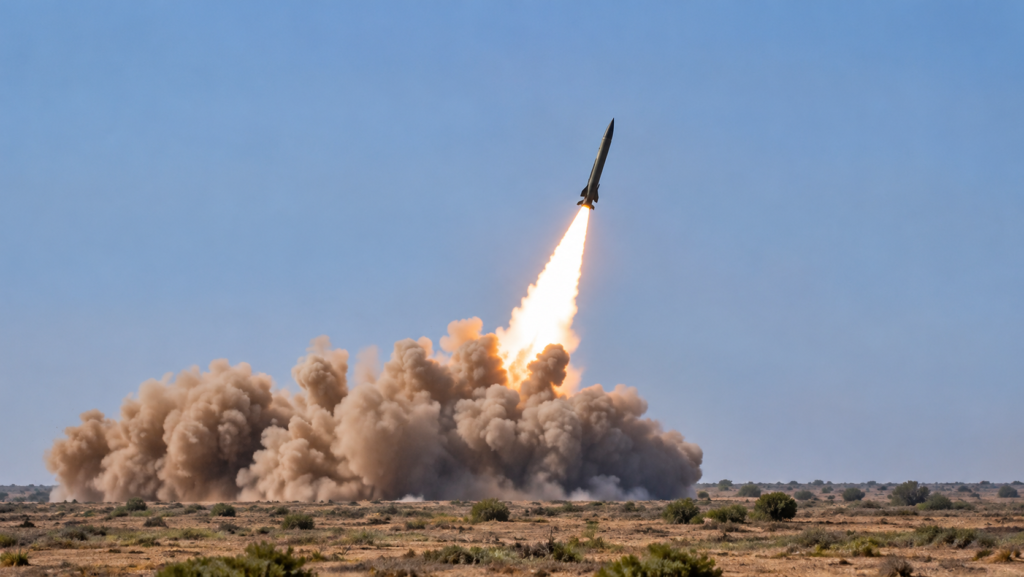
RAWALPINDI — Pakistan’s military announced the successful test launch of an extended-range version of its Fatah-2 ballistic missile on Tuesday, marking another development in the country’s missile programme as regional security concerns bring renewed attention to precision-strike capabilities, defence technology and the strategic balance in South Asia.
The Inter-Services Public Relations (ISPR), the military’s media wing, described the Fatah-2 Extended Range weapon system as a hypersonic ballistic missile equipped with advanced navigation and modern avionics. According to the military, its flight characteristics and manoeuvrability are designed to improve precision and help penetrate missile defence systems. The announcement did not provide sufficient independently verifiable technical data to establish the system’s full operational performance under combat conditions.


The test was witnessed by the commander of the Army Rocket Force Command, senior military officers and scientists and engineers involved in the programme. The military said the launch demonstrated progress in the development of systems capable of engaging targets at greater distances. President Asif Ali Zardari, Prime Minister Shehbaz Sharif and senior military leaders congratulated the personnel involved in the project.
The announcement follows Pakistan’s October 6 test of an extended-range Fatah-4 ground-launched cruise missile, indicating continued work on different types of precision-strike weapons. Ballistic and cruise missiles follow different flight profiles and present different challenges for defensive systems. Developing both categories can provide military planners with a wider range of conventional options, although their practical effectiveness depends on testing, integration, intelligence and operational readiness.
For Pakistan, the significance of the latest launch extends beyond the missile itself. The development of longer-range and more manoeuvrable systems is connected to broader questions about how conventional deterrence is maintained in a region where both Pakistan and India possess nuclear weapons. Changes in conventional military capabilities can influence strategic calculations, even when new systems are not themselves described as nuclear weapons.
The military’s description of the Fatah-2 ER as hypersonic also requires technical context. Hypersonic speed alone does not establish that a missile can reliably evade advanced defences, since many ballistic missiles travel at extremely high velocities during portions of their flight. The effectiveness of any particular system depends on its trajectory, manoeuvrability, detection characteristics and the defensive technology it encounters.
The latest announcement therefore provides evidence of a reported successful test, but not independent proof of every claimed operational capability. Details such as the precise tested range, payload, flight profile and performance against representative missile defences would be necessary for a fuller technical assessment. Those distinctions are important when evaluating military announcements in an environment where governments have strong incentives to demonstrate technological progress.
Pakistan’s emphasis on precision-strike systems also raises questions about defence priorities and the resources required to develop, manufacture and maintain increasingly sophisticated weapons. Missile programmes depend on specialised engineering, testing infrastructure, electronics and sustained institutional investment. Their economic costs and potential industrial benefits are difficult to assess without detailed public expenditure data.
The strategic implications extend to crisis management between neighbouring states. Systems capable of striking targets at greater distances may strengthen a country’s conventional military options, but they can also increase the importance of reliable communication and accurate threat assessment during periods of tension. Misinterpretation of military movements or intentions can become particularly dangerous when decision-makers operate under severe time pressure.
Pakistan’s latest test is therefore both a technological announcement and a development with broader security implications. The extent to which the Fatah-2 ER changes operational capabilities will depend on further testing, deployment decisions and independently assessable performance. Its wider significance will be determined by how the system fits into Pakistan’s defence planning and the evolving strategic environment in South Asia.