
By Ayan Irfan — The Changer
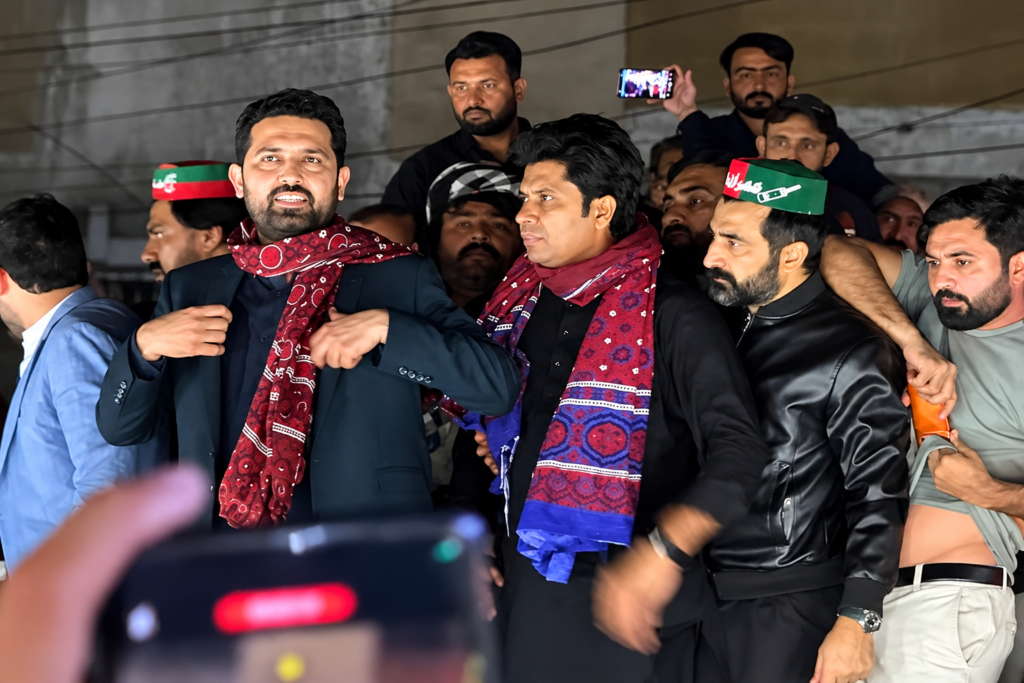
KARACHI: Pakistan Tehreek-e-Insaf’s confrontation with authorities in Karachi on Sunday offered an early test of a much larger political strategy: whether the party can move supporters across provincial boundaries and sustain street mobilisation before its planned September 27 march on Islamabad.
Khyber Pakhtunkhwa Chief Minister Sohail Afridi’s Sindh tour was planned well before Sunday’s dispute over blocked roads around Mazar-e-Quaid. PTI announced on August 27 that Afridi would travel through several Sindh cities before reaching Karachi on September 6 for a rally at Shahrah-e-Quaideen. His provincial tour therefore represents one component of a broader mobilisation campaign rather than an isolated visit to Pakistan’s largest city.


That distinction changes the significance of Sunday’s confrontation. Containers and road closures were reported around parts of central Karachi as Afridi’s convoy approached the city, while police said political gatherings would not be permitted around Mazar-e-Quaid. Afridi accused the PPP-led Sindh government of obstructing his convoy and challenged PPP Chairman Bilawal Bhutto-Zardari to explain the restrictions, coming a day after Bilawal publicly welcomed him to Sindh and called for political tolerance.
The reason for the restrictions, however, remains contested. Karachi Traffic Police cited security for road closures around Mazar-e-Quaid, while a senior police officer told Dawn that authorities had received a security threat and said the closures were not imposed to stop PTI’s rally. The district administration had not granted permission for the gathering at Mazar-e-Quaid, according to police, although officials indicated PTI could potentially organise at alternative locations including near Toll Plaza or Jail Chowrangi.
That makes Sunday’s episode more consequential than a dispute between Afridi and the Sindh government. PTI is preparing for a nationwide mobilisation culminating in its September 27 Islamabad march, which Afridi has repeatedly described as a decisive campaign linked to demands surrounding imprisoned party founder Imran Khan. The party’s planning extends beyond bringing supporters directly to Islamabad: reporting on its preparations indicates workers from other parts of Pakistan have been instructed to reach Khyber Pakhtunkhwa ahead of the march, with caravans expected to assemble before moving towards the federal capital.
Sindh therefore provides an important rehearsal. Unlike mobilisation inside PTI-governed Khyber Pakhtunkhwa, organising supporters across Sindh requires the party to operate under a rival provincial government, negotiate local permissions and maintain movement across hundreds of kilometres. Afridi’s journey through Shikarpur, Shahdadkot, Larkana, Naushehro Feroze and Hyderabad before the Karachi leg has allowed PTI to test precisely those organisational capabilities.
The Karachi dispute also exposes a political contradiction that could follow both PTI and PPP beyond Sunday. Bilawal’s public message welcoming Afridi to Larkana emphasised tolerance, respect and coexistence in democratic politics. Afridi responded by arguing that democracy also required freedom of political activity, an independent judiciary, parliamentary autonomy and a free press. Less than a day later, those competing definitions of political freedom moved from social media into a practical dispute over roads, rally permissions and security.
For PPP, the political risk lies in allowing security measures to be interpreted as suppression of an opposition campaign, even when authorities maintain that the restrictions are threat-driven. For PTI, the challenge is different: converting confrontations with provincial administrations into sustained mobilisation without allowing disputes over permissions or public order to derail the September 27 campaign.
Karachi may consequently matter less for the rally PTI hoped to hold on Sunday than for what the city reveals about the weeks ahead. If September 27 becomes a genuinely nationwide mobilisation, PTI will need to reproduce across Pakistan what Afridi’s Sindh tour is attempting now — moving supporters through jurisdictions it does not control while keeping the party’s political message intact.
Sunday’s roadblocks have therefore produced an unintended preview. Three weeks before the planned Islamabad march, PTI has encountered the logistical, legal and security obstacles that could determine whether its September 27 call develops into a national show of strength or remains primarily a Khyber Pakhtunkhwa-driven mobilisation.