
By Uzair Saleem — The Changer
PESHAWAR — Pakistan Tehreek-e-Insaf launched a multi-day march towards Islamabad on Sunday, adopting a phased mobilisation across Khyber Pakhtunkhwa rather than an immediate push into the federal capital after negotiations with the government failed to defuse the latest confrontation over jailed former prime minister Imran Khan.
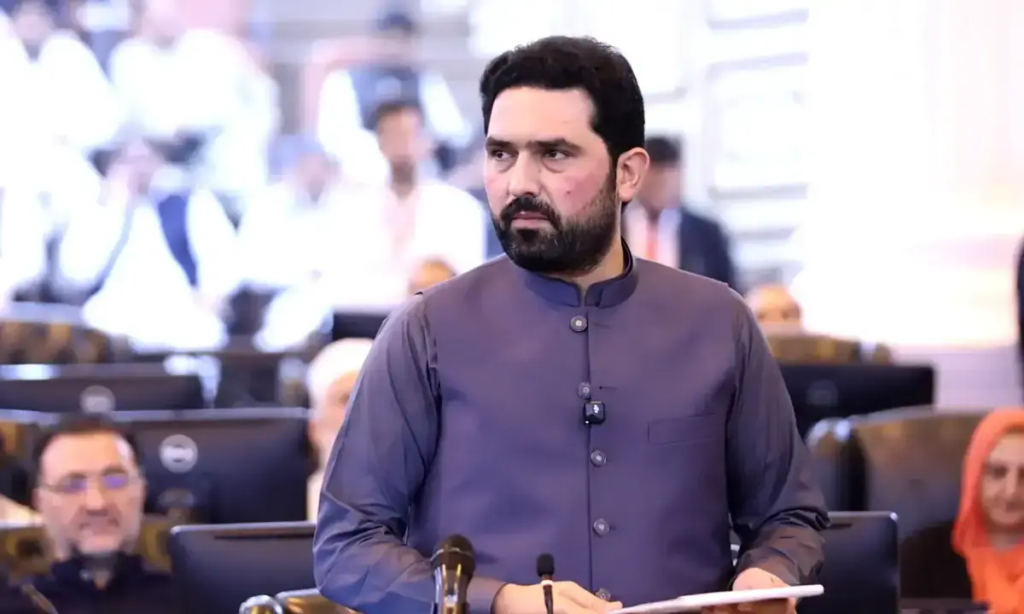
Khyber Pakhtunkhwa Chief Minister Sohail Afridi led the march from Gandi Chowk in Lakki Marwat, with thousands of supporters joining a convoy of vehicles before it moved towards Karak. The demonstration is demanding Khan’s release and comes after a second round of government-opposition negotiations ended without an agreement capable of stopping the protest.


The route chosen by PTI makes the march more than a single-day Islamabad rally. Under the party’s announced plan, supporters from different districts will progressively join the convoy as it moves through southern and central parts of Khyber Pakhtunkhwa, potentially allowing PTI to expand the size of the mobilisation before deciding on its final approach to the capital.
Afridi told supporters that PTI would not accept policies it considered contrary to the interests of Khyber Pakhtunkhwa and the Pashtun population. He also linked the protest to the province’s worsening security situation, challenging the existing counterterrorism approach and claiming that PTI’s preferred policies could restore peace.
His remarks broadened the political message of the march beyond Khan’s imprisonment. While securing the former prime minister’s release remains the central rallying demand, Afridi is increasingly presenting the movement as a challenge to both the federal government’s political authority and its security policy in a province facing persistent militant violence.
The march began after attempts to find a negotiated way out of the confrontation failed. Government and opposition representatives held talks before Sunday’s mobilisation, but remained divided over key issues including access to Khan in prison and the approach to terrorism in Khyber Pakhtunkhwa.
That failure has shifted the dispute back from negotiations to the streets. PTI had originally announced the march for September 27 before postponing it to October 4, giving both sides additional time for talks but also allowing authorities to strengthen security preparations around Islamabad and key routes leading towards the capital.
The scale of those preparations has already produced consequences far beyond party politics. Shipping containers have been positioned along approaches to Islamabad and Rawalpindi to restrict possible protest routes, while the requisitioning of trucks and containers has disrupted freight movements and contributed to a buildup of cargo.
The government’s security strategy reflects memories of previous PTI demonstrations that ended in confrontation with law enforcement. Federal officials have said protesters will not be permitted to violently enter Islamabad, while PTI leaders maintain that the current march is intended to remain peaceful.
Signs of the difficulties facing PTI’s mobilisation emerged on Sunday when a separate convoy led by former Khyber Pakhtunkhwa chief minister Ali Amin Gandapur turned back towards Dera Ismail Khan after encountering road restrictions and security concerns near Yarik.
Gandapur said the decision was intended to avoid unnecessary risks to party workers rather than signal withdrawal from the protest campaign. He urged supporters to avoid vandalism and confrontation with law enforcement, although some participants reportedly wanted the convoy to remain on the road and continue towards the main march.
The episode illustrated one of the central challenges facing PTI’s phased strategy. By stretching the march across several days and districts, the party can gather supporters along the route, but it also gives authorities more opportunities to restrict roads, impose security measures and disrupt individual convoys before they merge into a larger force.
Afridi’s announced schedule calls for the main convoy to move from the Karak area towards Kohat before proceeding through the Peshawar region. Additional supporters from Kohat, Hangu, Kurram, Orakzai, Peshawar, Charsadda and Mohmand are expected to join at different stages.
The party plans to gather supporters from across Khyber Pakhtunkhwa near Khairabad on October 8. Afridi has deliberately left the next phase unspecified, saying further plans will be announced once the convoy reaches that point.
That uncertainty leaves the most politically sensitive part of the march unresolved: exactly how and when PTI intends to move towards Islamabad.
Authorities have meanwhile imposed restrictions under Section 144 across several districts, citing public safety and security threats. Some measures limit the movement of people and vehicles along specified routes, adding another layer of uncertainty to PTI’s attempt to build momentum as the convoy moves north.
The developing confrontation therefore differs from a conventional protest concentrated around Islamabad. PTI is attempting to accumulate political pressure gradually, while the government is using geographic restrictions and security deployments to prevent that mobilisation from becoming a mass entry into the capital.
For both sides, the critical point may come later in the week rather than at the march’s starting point. If PTI succeeds in adding supporters at successive stops, the Khairabad gathering could become the moment when the protest shifts from a provincial mobilisation into a direct challenge to the federal government’s control of Islamabad’s approaches.
If authorities successfully fragment the convoys before then, however, PTI could arrive at that stage with considerably less momentum than its leadership expects.
With negotiations stalled and neither side publicly backing away from its position, the long march has opened a new phase of Pakistan’s political confrontation — one likely to be determined not merely by how many supporters departed Lakki Marwat, but by how many remain together when the movement reaches the gates of the federal capital.