
By Shahnoor Saqib | The Changer
ISLAMABAD — Pakistan’s declaration that it stands “shoulder to shoulder” with Saudi Arabia after an alleged drone attempt near Makkah carries greater weight than a routine statement of solidarity: it comes as Islamabad faces its first serious test of how far its recently established collective-defence commitments with Riyadh and Ankara could extend during a rapidly escalating regional conflict.
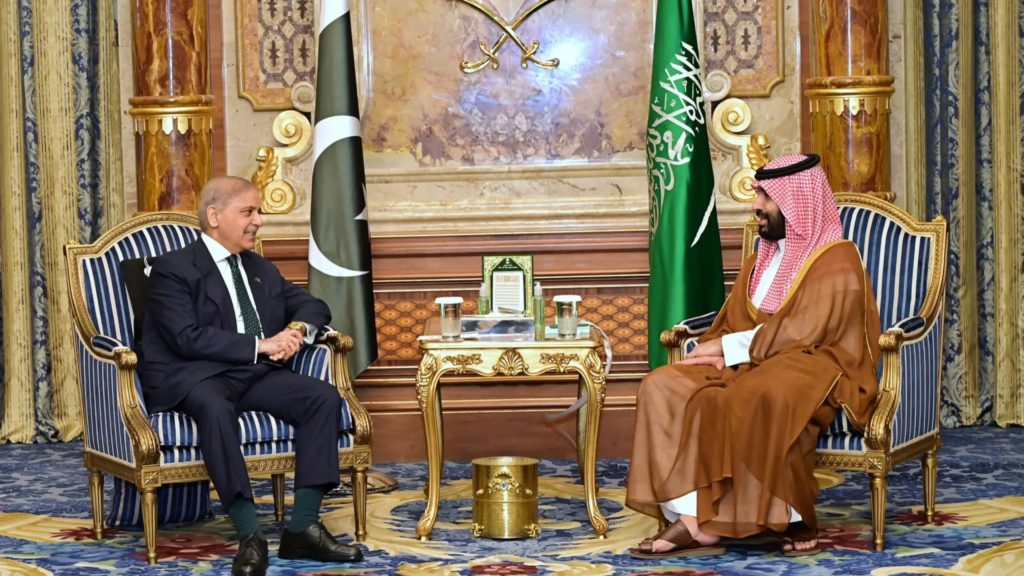
Prime Minister Shehbaz Sharif on Wednesday strongly condemned what Saudi authorities described as an attempted Houthi drone attack targeting Makkah and said Pakistan stood unwaveringly with the kingdom in defence of its sovereignty, territorial integrity and the security of Islam’s holy sites.


Saudi Arabia said its air defences intercepted and destroyed a drone south of Makkah before it could enter restricted airspace over the holy city. The Saudi-led coalition attributed the drone to Yemen’s Houthis and described the security of Makkah, the Two Holy Mosques and pilgrims as a red line.
The Houthis, however, denied that they had attempted to target Makkah or another Islamic holy site. That denial is significant: while the group has acknowledged other recent attacks on Saudi territory, responsibility for an attempted strike specifically directed at Makkah remains disputed between the Saudi-led coalition and the Houthis.
Pakistan’s Foreign Ministry nevertheless issued an unequivocal condemnation, describing the reported attack as a violation of Saudi sovereignty and saying Islamabad stood firmly with the kingdom in safeguarding the Haramain Sharifain and protecting pilgrims, residents and citizens.
But Shehbaz’s statement contained two messages that point in different directions.
The first was an unusually emphatic security pledge. He said Pakistan stood with Saudi Arabia in defending both the kingdom’s territorial integrity and the sanctity of the holy sites. The second was a warning against allowing the confrontation to expand further: the prime minister urged all parties to exercise maximum restraint and said dialogue and diplomacy remained the sustainable route to peace.
That combination — solidarity with Riyadh while calling for de-escalation — illustrates the increasingly difficult position Islamabad must navigate as fighting in Yemen spills across Saudi borders.
The stakes are also higher because Pakistan’s support is no longer defined solely by decades of bilateral defence ties.
Pakistan, Saudi Arabia and Türkiye signed the Makkah Joint Defence Agreement last month, establishing a collective-deterrence framework under which an armed attack against one member can trigger obligations from the others. Recent Houthi attacks inside Saudi Arabia have already raised questions about when that commitment moves from deterrence on paper to action.
Only days ago, Pakistan’s Foreign Ministry said no military response under the agreement was being discussed at that stage. Defence Minister Khawaja Asif has since used stronger language, saying continued aggression or a spillover of the Yemen conflict into Saudi territory could make the pact operational.
Following the latest incident, Asif went further, saying Pakistan would stand with Saudi Arabia “practically and diplomatically” if the confrontation escalated. He also argued that Pakistan’s commitment to protecting Makkah and Madinah existed independently of any formal defence treaty.
That shift is what makes the latest episode more consequential than another exchange of condemnations.
The central question is no longer whether Pakistan politically supports Saudi Arabia — successive governments have made that position clear. The emerging question is what Islamabad considers the threshold for translating the Makkah pact’s collective-defence language into practical measures.
For now, Pakistani officials have not publicly specified what those measures could involve, and Islamabad continues to advocate restraint rather than openly announce military involvement.
That leaves Pakistan trying to maintain two objectives simultaneously: demonstrating that its security commitment to Saudi Arabia is credible while avoiding steps that could pull it directly into another expanding Middle Eastern conflict.
The next major development may therefore come not from another statement of solidarity, but from how Pakistan, Saudi Arabia and Türkiye interpret the defence pact if attacks on Saudi territory continue.