
Pakistan | By AP
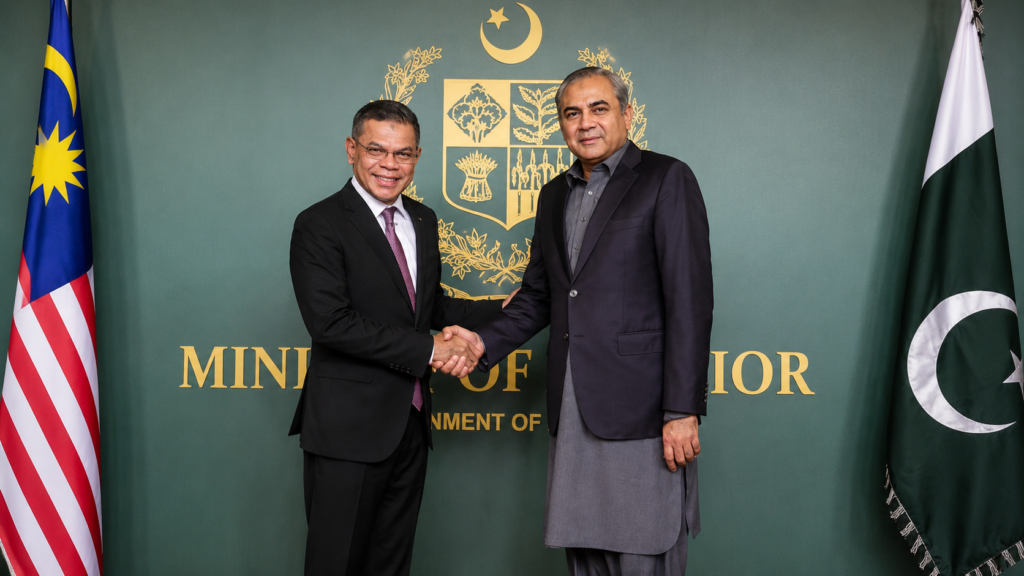
ISLAMABAD — Pakistan and Malaysia agreed on Saturday to strengthen intelligence sharing and establish a Joint Working Group between their interior ministries, expanding security cooperation against terrorism, narcotics trafficking, human smuggling, illegal immigration and cybercrime. The understanding was reached during talks in Islamabad between Interior Minister Mohsin Naqvi and Malaysian Home Minister Saifuddin Nasution bin Ismail, followed by delegation-level discussions involving senior security and law-enforcement officials.
The two sides agreed that closer intelligence exchange would be central to identifying terrorist and drug-trafficking networks operating across borders, while coordinated measures would be developed against migrant-smuggling operations. Pakistan and Malaysia also discussed cooperation between Pakistan’s National Police Academy and the Royal Malaysia Police College, including training programmes and exchanges of law-enforcement expertise. Cooperation in coast guard operations was another area identified for expansion, with Naqvi saying Pakistan was interested in benefiting from Malaysia’s experience in the sector.


The talks went beyond traditional counterterrorism cooperation. Officials discussed illegal immigration and cybercrime as increasingly interconnected transnational threats, while the creation of the Joint Working Group is intended to provide the two interior ministries with a permanent mechanism for implementing agreements rather than relying solely on periodic ministerial meetings. A high-level Pakistani delegation is also expected to visit Malaysia to advance the understandings reached in Islamabad.
President Asif Ali Zardari separately met Saifuddin at Aiwan-e-Sadr and called for deeper Pakistan-Malaysia cooperation in law enforcement, counterterrorism, narcotics control and efforts against human trafficking and migrant smuggling. The presidency’s statement gives the security initiative broader political backing beyond the interior ministries and places it within Islamabad and Kuala Lumpur’s expanding bilateral relationship.
Economic mobility was also part of the discussions. Naqvi called Malaysia an important destination for Pakistani travellers and expressed hope that Kuala Lumpur could increase employment quotas for Pakistanis, allowing more workers to travel through legal migration channels. Both countries also discussed tourism promotion and easier visa procedures.
The Changer Angle: Fighting Smuggling While Expanding Legal Migration
The most interesting element of the agreement is the connection between security cooperation and legal mobility. Pakistan and Malaysia are not discussing human smuggling in isolation: at the same meeting where officials sought stronger intelligence sharing against illegal migration networks, Pakistan also pushed for increased Malaysian work opportunities for Pakistani citizens.
That creates a potentially more effective policy model. Enforcement can disrupt smugglers, but expanding credible legal employment routes can also reduce the market those networks exploit. If increased intelligence sharing is eventually combined with easier legitimate recruitment, verified employment channels and stronger action against trafficking networks, the partnership could address both the criminal network and one of the pressures that enables it.
The creation of a Joint Working Group is therefore more significant than another bilateral declaration of cooperation. It gives Islamabad and Kuala Lumpur a mechanism through which intelligence agencies, immigration authorities, police and other security institutions could potentially coordinate continuously. The real test will be whether that structure produces operational intelligence exchanges, investigations and measurable action against cross-border networks.