
By Naeema Saleem — The Changer
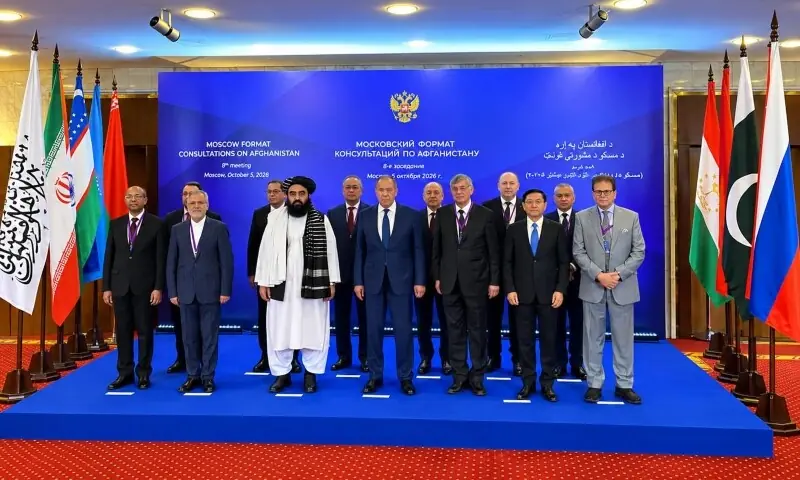
MOSCOW — A widening dispute between Pakistan and Afghanistan over militant sanctuaries spilled into one of the region’s main diplomatic forums on Monday, preventing participants in the Moscow Format from adopting a joint statement and exposing a deeper disagreement over whether Taliban-ruled Afghanistan remains a source of cross-border terrorism or has become a partner in containing it.
Pakistan used the eighth Moscow Format Consultations on Afghanistan to deliver one of its strongest regional presentations of the security case against Kabul. Ambassador Mohammad Sadiq, Pakistan’s Special Representative for Afghanistan, said terrorism remained at the core of Afghanistan’s problems and linked the threat to what Islamabad describes as ties between the Taliban authorities and militant organisations operating from Afghan territory. He said more than 4,700 Pakistanis had been killed over the past three years in terrorism emanating from Afghanistan, while defending Pakistan’s recent counterstrikes as intelligence-based and defensive actions.


The Taliban government rejected that account, turning what was intended as a regional consultation on security, economic cooperation and connectivity into another arena for the escalating confrontation between Islamabad and Kabul. Afghan Foreign Minister Amir Khan Muttaqi accused Pakistan of using force and maximum pressure rather than diplomacy and said Pakistani strikes had killed Afghan civilians, including women and children. Kabul has consistently denied Pakistan’s allegation that it shelters militants responsible for attacks across the border and argues that Islamabad should address its internal security problems rather than attribute them to Afghanistan.
The disagreement became consequential when diplomats attempted to finalise the meeting’s joint statement. Russian presidential envoy for Afghanistan Zamir Kabulov said the Afghan and Pakistani delegations could not agree on wording connecting Afghanistan to terrorism, leaving the Moscow Format without the final declaration traditionally issued after its consultations. Kabulov said the Afghan side believed Afghanistan had been mentioned too frequently in a terrorist context, while Moscow found the objection surprising because similar language had appeared in the previous year’s document.
The collapse of the statement is more significant than a disagreement over diplomatic wording. Pakistan has been attempting to persuade regional powers that militant activity based in Afghanistan represents a collective security threat rather than a bilateral grievance, while the Taliban government is seeking broader diplomatic legitimacy by portraying itself as a stabilising authority capable of controlling Afghan territory. Those two narratives collided directly in Moscow, making even a consensus document unacceptable to one side or the other.
Pakistan’s argument is centred principally on the Tehreek-e-Taliban Pakistan, although Islamabad says other militant organisations also operate from Afghan soil. Pakistani officials maintain that the Taliban’s return to power in 2021 created greater operating space for militants targeting Pakistan and that repeated diplomatic engagement failed to produce verifiable action against their networks. Islamabad has increasingly stated that dialogue can only produce durable results if Kabul prevents Afghan territory from being used to organise, facilitate or launch attacks against Pakistan.
That position has hardened considerably over the past year. Pakistan initially pursued intensive diplomatic engagement with the Taliban authorities, combining political contacts with efforts to expand trade, connectivity and economic cooperation, but officials say rising militant violence eventually crossed a threshold at which security concerns could no longer be separated from bilateral relations. Islamabad now says future normalisation requires concrete and verifiable assurances that Afghan territory will not be used against Pakistan.
The Taliban government sees the relationship differently. Kabul argues that Pakistan’s use of military force undermines Afghan sovereignty and makes political engagement more difficult, while Muttaqi told the Moscow gathering that outstanding problems should be settled through dialogue and diplomacy. The competing positions have created a cycle in which Pakistan demands security action before deeper normalisation, while Afghanistan argues that coercive Pakistani measures themselves are obstructing the political environment needed to resolve the dispute.
Russia’s role adds another layer to the confrontation. Moscow became the first country to formally recognise the Taliban government in 2025 and has since expanded political engagement with Kabul, while Russian Foreign Minister Sergey Lavrov on Monday praised Taliban efforts against Islamic State and narcotics trafficking. At the same time, Russia maintains close security relationships with Central Asian states and has repeatedly acknowledged the danger posed by extremist organisations operating in and around Afghanistan.
That leaves Moscow attempting to reconcile two assessments that are becoming increasingly difficult to hold together. Russia wants to integrate the Taliban authorities into regional diplomatic and economic structures and credits Kabul with making progress against some extremist groups, but Pakistan is demanding greater regional acknowledgement that other militant organisations continue to operate from Afghan territory. The failed statement demonstrated the limits of Moscow’s ability to bridge those positions when Pakistan and Afghanistan fundamentally disagree over how the security problem itself should be described.
The broader composition of the meeting made that failure particularly important. Representatives from China, India, Iran, Kazakhstan, Kyrgyzstan, Tajikistan and Uzbekistan joined Afghanistan, Pakistan and Russia, while Belarus and Egypt attended as guests. These countries have different relationships with the Taliban but share interests in preventing transnational militancy, narcotics trafficking and instability from spreading beyond Afghanistan’s borders.
China has especially strong reasons to prevent the Pakistan-Afghanistan confrontation from worsening. Beijing maintains a strategic partnership with Islamabad while also developing relations with the Taliban authorities and has previously attempted to facilitate dialogue between the two neighbours. Pakistan and China have separately identified militant organisations based in Afghanistan as security concerns, meaning prolonged hostility between Islamabad and Kabul could complicate Beijing’s regional connectivity and investment objectives.
Iran and the Central Asian republics face a similar dilemma. They want a stable Afghanistan integrated into regional trade networks but remain concerned about militant organisations capable of operating across borders. None has an interest in Afghanistan returning to international isolation, yet regional economic integration becomes substantially more difficult if neighbouring governments do not have confidence that Afghan territory is securely controlled.
Pakistan’s presentation in Moscow therefore served two objectives. Islamabad sought to defend its own security actions as measures of self-defence while simultaneously pressing regional governments to treat militancy originating from Afghanistan as a shared threat. Turning that argument into a regional consensus, however, is considerably harder because participating countries differ over how much pressure should be placed on the Taliban and how much credit Kabul should receive for improvements in security since 2021.
For the Taliban, the dispute creates an obstacle to its campaign for wider diplomatic acceptance. Kabul wants international recognition, foreign investment and integration into regional economic projects, but unresolved allegations over militant sanctuaries provide neighbouring states with reasons to limit that engagement. The more terrorism dominates regional discussions about Afghanistan, the harder it becomes for the Taliban to shift the diplomatic agenda toward trade, infrastructure and formal recognition.
Russia has indicated that it is prepared to help reduce tensions between Islamabad and Kabul if both sides seek its involvement. Kabulov nevertheless stressed that the Moscow Format is designed primarily to coordinate regional cooperation rather than resolve bilateral disputes, making clear that Moscow does not want the platform transformed into a permanent mediation mechanism for Pakistan and Afghanistan.
The inability to issue a joint statement ultimately provided a clearer picture of regional divisions than a carefully negotiated declaration might have done. The countries gathered in Moscow broadly agree that Afghanistan should be peaceful, economically connected and free from transnational militant threats, but they no longer agree sufficiently on how terrorism inside Afghanistan should be described or where responsibility for addressing it lies.
For Pakistan, terrorism has become the condition through which almost every other aspect of the Afghan relationship is now viewed. For Kabul, accepting that framing risks undermining its claim that the Taliban have restored security and established effective control of the country. Until those competing positions move closer together, Afghanistan’s regional integration will remain constrained by the same issue Monday’s meeting was unable to put into agreed diplomatic language.
The Moscow gathering was supposed to demonstrate regional convergence on Afghanistan. Instead, its most consequential outcome was the absence of an agreement, revealing that the Pakistan-Afghanistan security dispute has grown powerful enough to fracture a regional consensus that both governments ultimately need.