
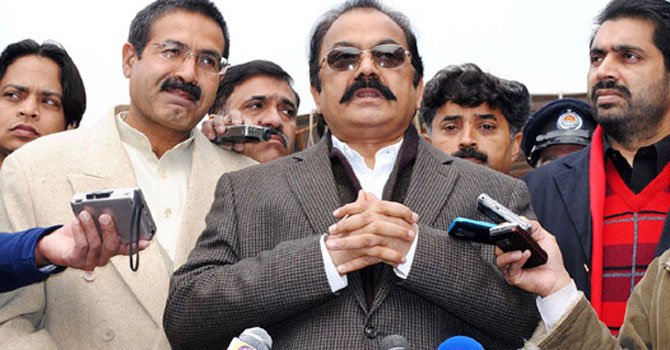
LAHORE, Sept 12 — Pakistan’s increasingly public debate over creating new provinces has reached an unusual political stage: ministers and parties are discussing referendums, administrative restructuring and new federating units, but Prime Minister Shehbaz Sharif’s government has yet to put a proposal before the cabinet, Parliament has no formal plan before it and the ruling PML-N has not settled its own position. Prime Minister’s Adviser on Political Affairs Rana Sanaullah said on Saturday that any referendum would first require approval through Parliament and that the government could not unilaterally send the issue to voters, effectively placing constitutional procedure — and difficult parliamentary arithmetic — between the rapidly expanding political campaign and any actual redrawing of Pakistan’s provincial map.
Sanaullah told reporters in Lahore that Parliament was the appropriate forum for determining whether Pakistan should create additional provinces and said political parties should take their competing proposals there rather than attempting to settle the issue through seminars, economic forums or public statements. He said the matter had not yet reached the federal cabinet and PML-N consultations were still underway, adding that the party would formulate its position after considering views from its organization down to district and union-council level. His comments expose a widening gap between the intensity of the public debate and the absence of a government blueprint: there is still no agreed number of new provinces, no settled boundaries, no cabinet-approved proposal and no parliamentary legislation setting out what the restructuring would actually look like.
The referendum question is particularly important because it can easily obscure the harder constitutional obstacle. Article 48(6) of the Constitution provides a mechanism under which a question of national importance can be referred to a referendum after approval by a joint sitting of Parliament, but a nationwide vote would not by itself redraw provincial boundaries. Altering the limits of an existing province engages the Constitution’s amendment procedure, including Article 239(4), under which a constitutional amendment affecting a province’s limits cannot be presented for presidential assent unless the relevant provincial assembly has approved it by at least a two-thirds majority. A constitutional amendment must also clear both houses of Parliament by the required two-thirds threshold. Sanaullah’s remarks therefore place a referendum, if Parliament chooses one, inside a much larger constitutional process rather than offering it as a shortcut around legislatures.


That distinction changes the political calculation. The PML-N-led federal coalition can advance ordinary government business with its parliamentary allies, but restructuring the federation requires a degree of agreement far beyond a normal cabinet decision. The PPP has already strongly resisted proposals that could divide Sindh, whose assembly passed a resolution rejecting attempts to alter the province’s boundaries, while MQM-P has advocated additional administrative units and Interior Minister Mohsin Naqvi has publicly argued that Pakistan’s population and governance challenges justify reconsidering the existing provincial structure. PTI Chairman Barrister Gohar Ali Khan has meanwhile called for broad consensus comparable to the process surrounding the 18th Constitutional Amendment. The result is not a simple government-versus-opposition dispute: parties that cooperate at the federal level are themselves divided over what provincial restructuring should mean.
Sanaullah’s intervention also weakens the impression that a referendum or new-provinces package is already moving through the machinery of government. He said there had been no cabinet consideration of the matter, while earlier statements from him stressed that neither a bill nor a resolution had formally entered Parliament. He has also argued that old Punjab Assembly resolutions concerning South Punjab and Bahawalpur cannot simply be treated as a standing mandate for restructuring today and that fresh legislative action would be required. That makes the current debate politically significant but institutionally preliminary: Pakistan is debating the architecture of its federation before the federal government has even produced the document around which such a debate could formally organize.
The parliamentary numbers explain why that absence matters. PPP cooperation is central to the federal coalition’s ability to assemble the supermajorities necessary for major constitutional change, yet the party has warned against altering existing provincial boundaries without extensive consultation and provincial consent. PPP Secretary-General Nayyar Hussain Bukhari has argued that the federal cabinet should first consider any serious proposal and that stakeholders and political parties would then need to be brought into a consensus-building process. Without PPP support, the government’s path toward the constitutional thresholds required for restructuring would become substantially more difficult, making coalition management as important to the new-provinces debate as the geographic maps being proposed publicly.
There is another complication: even agreement that Pakistan needs administrative reform does not produce agreement on what a “new province” should be. Proposals circulating in political debate range from restoring or creating a Bahawalpur province and establishing South Punjab to dividing existing provinces into smaller administrative units, reconsidering Karachi’s governance and strengthening local government instead of creating additional federating units. Each model redistributes something different — Senate representation, National Assembly constituencies, National Finance Commission resources, provincial bureaucracies, development budgets and control over local administration. A debate presented publicly as a question of whether smaller provinces would improve governance is therefore also a negotiation over political representation and the distribution of state resources.
That is where Saturday’s remarks become more consequential than another statement supporting parliamentary debate. The government is effectively acknowledging that Pakistan has entered a national discussion over restructuring the federation without yet having a government proposal to restructure it. A referendum may eventually help establish public preferences, but it cannot answer the constitutional and political questions on its own: what boundaries would change, whether affected provincial assemblies would consent, how representation would be recalculated, how NFC resources would be distributed and whether the necessary parliamentary supermajorities could be assembled.
The Changer reported on September 7 that the new-provinces debate was moving beyond maps into a struggle over federal power, resources and representation. Saturday’s intervention is a material follow-up rather than a repetition because it clarifies where that political struggle currently stands institutionally: despite days of escalating national debate, the proposal has not reached the cabinet and Parliament has not yet been asked to approve a defined restructuring plan.
For Parliament, that creates the next decisive stage. Once an actual proposal arrives, parties will have to move beyond the politically attractive language of public consultation and answer questions that speeches can postpone: which provinces, which boundaries, which constitutional amendments and which fiscal arrangements. Until then, talk of a referendum remains an option within the constitutional process rather than evidence that Pakistan is approaching a national vote.
The central development is therefore not that Sanaullah has opened the door to a referendum. It is that he has defined how many doors must be opened before one can happen — cabinet policy, parliamentary agreement, potentially a joint-session decision on consulting voters, constitutional supermajorities and, where provincial boundaries are altered, approval from the affected provincial legislature. Pakistan’s new-provinces campaign has moved rapidly into national politics; the machinery required to turn it into a new federal map has barely started moving.