
By News Desk — The Changer
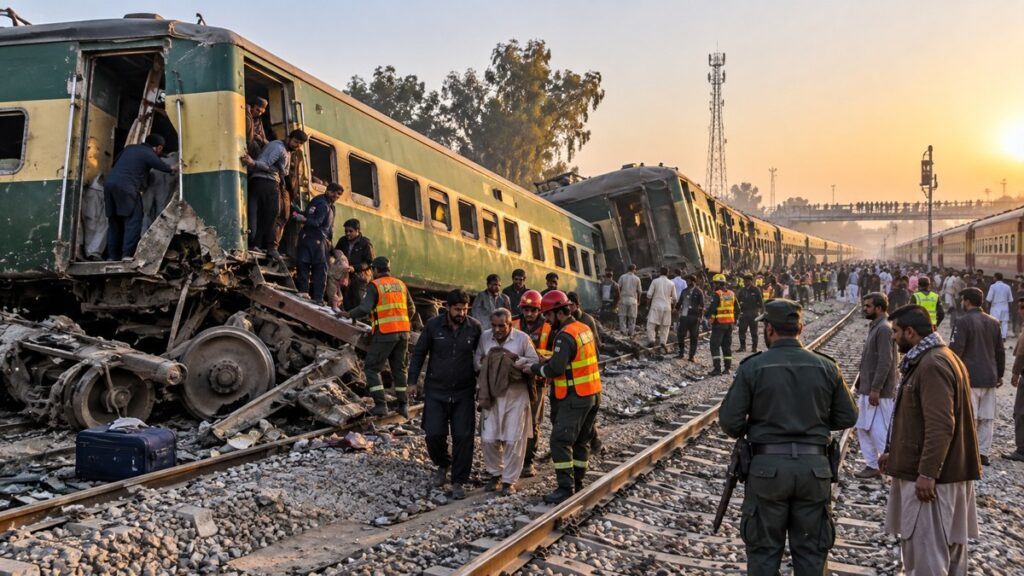
MULTAN — A passenger train carrying travellers from Karachi to Peshawar derailed near Multan on Tuesday, killing at least five people and injuring dozens, in a major accident that has renewed scrutiny of Pakistan Railways’ maintenance standards, mechanical inspections and responsibility for passenger safety.
The Rehman Baba Express derailed near Sher Shah Railway Station in Punjab province early Tuesday morning, with reports indicating that all 14 coaches came off the tracks. Several carriages overturned, leaving passengers trapped inside and prompting a large emergency response involving rescue workers, police, medical teams and railway personnel. The accident disrupted train operations while authorities worked to evacuate passengers and clear the damaged railway line.


Casualty figures varied as rescue and hospital authorities continued updating their records. Pakistan Railways’ chief executive confirmed five deaths and more than 40 injuries in an updated account, while some other reports placed the death toll at six. The differences underline the importance of obtaining a consolidated casualty statement from the authorities before treating any final figure as definitive.
The central question now facing investigators is not simply what caused the derailment, but whether existing safety procedures were capable of identifying a dangerous mechanical defect before the train continued its journey. Railway Minister Hanif Abbasi said the train had received mechanical attention at Samasatta Railway Junction before the accident. His remarks have brought the inspection process into focus, although the precise cause of the derailment has not been conclusively established.
An initial Pakistan Railways investigation indicated that a fault involving a passenger coach may have contributed to the derailment. That preliminary assessment requires further technical examination, including the condition of the coaches, wheel assemblies, braking equipment, track infrastructure and relevant maintenance records. No specific mechanical failure should be treated as the confirmed cause until investigators complete their findings.
The derailment also raises questions about how railway safety responsibilities are distributed between operational staff, maintenance teams, inspectors and senior management. Pakistan Railways operates an extensive passenger network connecting major cities and smaller communities, making consistent safety standards essential for travellers who depend on affordable long-distance transport. Failures in inspection or maintenance, when established, can have consequences far beyond an individual journey.
According to previously reported railway figures, Pakistan experienced 35 train accidents during the first six months of 2026. Earlier incidents have prompted concerns about rolling-stock condition, signalling equipment and the effectiveness of maintenance oversight. A parliamentary committee has also questioned whether disciplinary accountability is applied consistently throughout the railway administration rather than concentrating mainly on frontline employees.
The human consequences of Tuesday’s accident were immediate. Rescue personnel worked through damaged coaches to recover victims and transport injured passengers to hospitals in Multan, including Nishtar Hospital. Emergency teams deployed ambulances, firefighting equipment and rescue vehicles, while railway officials arranged medical assistance and alternative transport for affected travellers.
President Asif Ali Zardari and Prime Minister Shehbaz Sharif expressed grief over the deaths and directed authorities to provide assistance to the injured. The president called for a transparent investigation, while the prime minister instructed officials to accelerate rescue operations and ensure adequate medical treatment. Railway Minister Hanif Abbasi said compensation would be provided to victims and their families under the applicable railway insurance arrangements.
The minister also directed the Federal Government Inspector of Railways to investigate the accident. The inquiry will be important in determining whether the derailment resulted from a defect in a coach, a track-related problem, an operational failure or a combination of factors. Establishing a reliable sequence of events will be necessary before responsibility can be assigned.
Pakistan’s railway system has faced longstanding challenges involving ageing infrastructure, financial constraints and the need to modernise safety-critical equipment. These difficulties do not establish the cause of Tuesday’s accident, but they provide important context for evaluating whether existing inspection and maintenance arrangements are adequate. The effectiveness of any reforms will depend on documented technical improvements and sustained institutional oversight.
The government has announced arrangements for passenger assistance, including information desks, refunds where necessary and alternative transport services. Railway authorities also reported restoration of operations through Lodhran and Jahanian, although disruption on the affected route required additional recovery work. For passengers and their families, timely information and access to compensation remain immediate priorities.
The Multan derailment has therefore become more than another transport emergency. It presents a test of whether Pakistan Railways can turn a formal investigation into measurable safety improvements, transparent accountability and stronger passenger protection. The central measure of the official response will be whether investigators identify the underlying causes and whether the railway administration acts on their findings before another journey ends in tragedy.