
Pakistan | By Web Desk
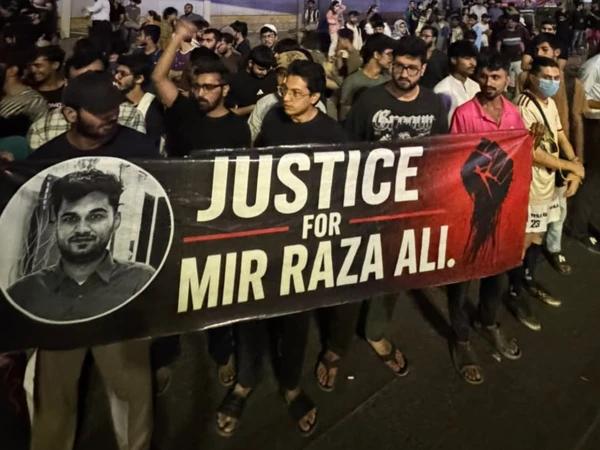
KARACHI — A judicial commission investigating the murder of 25-year-old Karachi businessman Mir Raza Ali formally began proceedings on Thursday, summoning his family, their lawyer Jibran Nasir and the Sindh government’s focal person for an August 28 hearing as scrutiny intensifies over the handling of a case that initially moved along a suicide theory before a second autopsy pointed to homicide.
The commission, headed by Sindh High Court Justice Umar Sial, has been given 30 days to examine the circumstances surrounding Ali’s death and, crucially, the conduct of the investigation itself. Its terms of reference empower it to assess whether the police probe was impartial and lawful, whether additional evidence or forensic examination is required, and whether police officers, medico-legal personnel or other government officials were negligent. It can also determine responsibility if evidence was concealed, altered or tampered with and recommend legal or departmental action.


Ali, an IBA graduate and businessman who owned the Wafflix eatery, disappeared after leaving his home in PECHS Block 2 on July 28. His body was discovered the following day in bushes in a hilly area opposite the University of Karachi in Gulistan-i-Jauhar. His father, Mir Hussain Ali, maintained from the outset that his son had been abducted and murdered, rejecting the initial direction of the police investigation towards possible suicide.
The case changed dramatically after Ali’s body was exhumed and subjected to a second post-mortem examination. The fresh examination found that he had been shot in the back and had suffered multiple injuries, including injuries to his head and face and fractures involving his nasal bone and skull. Those findings ruled out the suicide theory and led authorities to add a murder charge to the case.
The commission is therefore examining more than the identity of Ali’s killer. It is also confronting questions about how a death carrying signs later considered inconsistent with suicide was initially investigated in that direction, how medico-legal evidence was handled, and whether crucial material was properly collected and preserved. The investigation has already gone through changes in its police team and controversy surrounding the composition of the medical board responsible for the second autopsy.
Ali’s family, however, is opposing the very judicial commission that has now started work. Through Nasir, the family has petitioned the Sindh High Court to set aside the government’s decision and instead constitute an independent multi-agency Joint Investigation Team (JIT) involving Sindh Police, Rangers, the FIA, Intelligence Bureau, ISI and Military Intelligence. The petition seeks a fresh investigation under a senior officer with no previous involvement in the case.
That dispute creates an unusual situation: while the judicial commission begins examining possible failures in the murder investigation, the victim’s family is simultaneously asking the high court for a different investigative mechanism. The family argues that a commission principally produces findings and recommendations, whereas an empowered JIT would have the investigative machinery necessary to pursue suspects, forensic leads and potential wrongdoing by officials.
The family’s petition has also sought scrutiny of the earlier investigation team. Mir Raza’s parents previously wrote to Sindh Chief Minister Murad Ali Shah seeking his direct supervision of the murder investigation and demanding an inquiry into officials involved in the previous probe.
The August 28 proceedings could therefore become important not only for establishing how the commission intends to investigate Ali’s killing but also for addressing the family’s objections to the process. Justice Sial’s commission now has a broad mandate to determine whether the original investigation was conducted according to law and whether negligence, evidence mishandling or deliberate interference occurred.
Nearly a month after Mir Raza disappeared, the central question is no longer limited to who killed him. The second autopsy has also forced authorities to confront another question: why did an investigation involving a man later found to have been shot in the back and carrying multiple injuries initially move toward suicide — and did failures during those crucial early days compromise the search for his killers?