
By Jahanzaib Saqib — The Changer
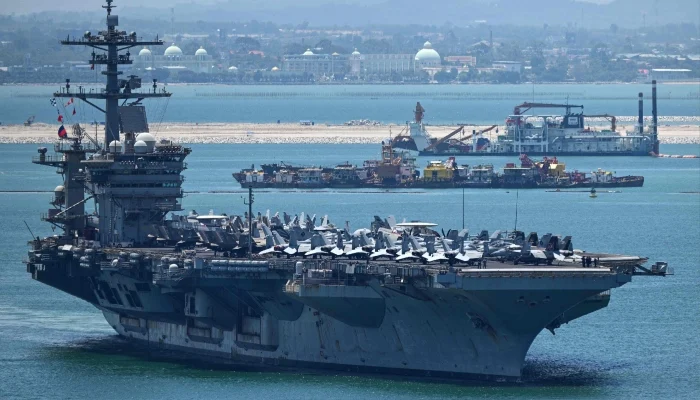
PATTAYA, Thailand: When the USS Abraham Lincoln sailed from Thailand on Sunday, the most eye-catching number from its five-day visit was the estimated $3 million its sailors and Marines poured into the local economy. But the strategically more consequential number was 265 — the number of consecutive days the U.S. aircraft carrier had gone without a port call before arriving at Laem Chabang, following an extraordinary deployment dominated by operations far from Southeast Asia.
The nuclear-powered carrier and accompanying elements of Carrier Strike Group 3 departed Thailand on September 6 after a scheduled visit that began on September 2. The U.S. Navy described the stop not simply as rest for thousands of personnel but as a demonstration of Washington’s continuing commitment to allies and partners as the strike group resumed operations in the U.S. 7th Fleet area. The Lincoln carries roughly 5,000 personnel and arrived with elements including Carrier Air Wing 9 and Destroyer Squadron 21, while accompanying U.S. warships made separate Thai port visits.


That positioning matters after the carrier’s unusually prolonged deployment. USNI News reported that the Lincoln had gone 265 days without a port call since Guam in December, after its deployment took it from the Western Pacific into the Middle East. Reuters reported that the extended mission included combat operations connected to the conflict with Iran, turning what began as another carrier deployment into an unusually demanding period at sea.
Thailand consequently served two purposes. For sailors and Marines, it offered the first substantial opportunity in months to leave the ship, rest and reconnect with ordinary life ashore. Strategically, however, the location brought the carrier back into the geography of America’s Indo-Pacific alliance network. Rear Adm. Robert Loughran, commander of Carrier Strike Group 3, explicitly said on arrival that the visit underscored the “strong and enduring” U.S.-Thailand alliance.
The historical depth of that relationship gives the port call additional significance. The U.S. Navy describes Thailand as Washington’s oldest partner in the region, tracing formal relations back 193 years to the Treaty of Amity and Commerce signed in 1833. The Lincoln’s presence therefore connected a modern instrument of American naval power with one of Washington’s longest-standing relationships in Asia at a time when U.S. military resources have faced competing demands across the Middle East and Indo-Pacific.
For Pattaya, however, geopolitics translated rapidly into economics. Mayor Poramase Ngampiches estimated enlisted U.S. personnel spent as much as 100 million baht, roughly $3 million, during the visit. Thousands of personnel moving through the resort region provided a concentrated injection of spending into hotels, restaurants, shops and entertainment businesses, although reporting from the city suggested the economic benefit was uneven and some local operators had expected an even larger boom.
The visit also demonstrated the less visible logistical dimension of maintaining a carrier strike group at sea for extraordinary periods. Rest, maintenance, supplies and crew morale are not peripheral considerations when naval deployments stretch across many months. The Navy itself described Laem Chabang as an opportunity for sailors and Marines to “rest and recharge,” while independent reporting documented fatigue and frustration among some crew members after the prolonged period aboard ship.
That makes the Lincoln’s departure more than the conclusion of an unusually lucrative few days for Pattaya. A carrier that had spent much of its deployment responding to a Middle Eastern conflict has re-emerged in the U.S. 7th Fleet operating area, and Washington deliberately used its first port call in nearly nine months to reaffirm an Asian alliance.
The $3 million spent ashore will remain the most tangible legacy for Pattaya businesses. Strategically, however, the larger story is where the carrier stopped after those months at sea — Thailand, an American treaty ally positioned inside the Indo-Pacific architecture Washington says it remains committed to despite simultaneous demands elsewhere.