
World / Middle East | By News Desk
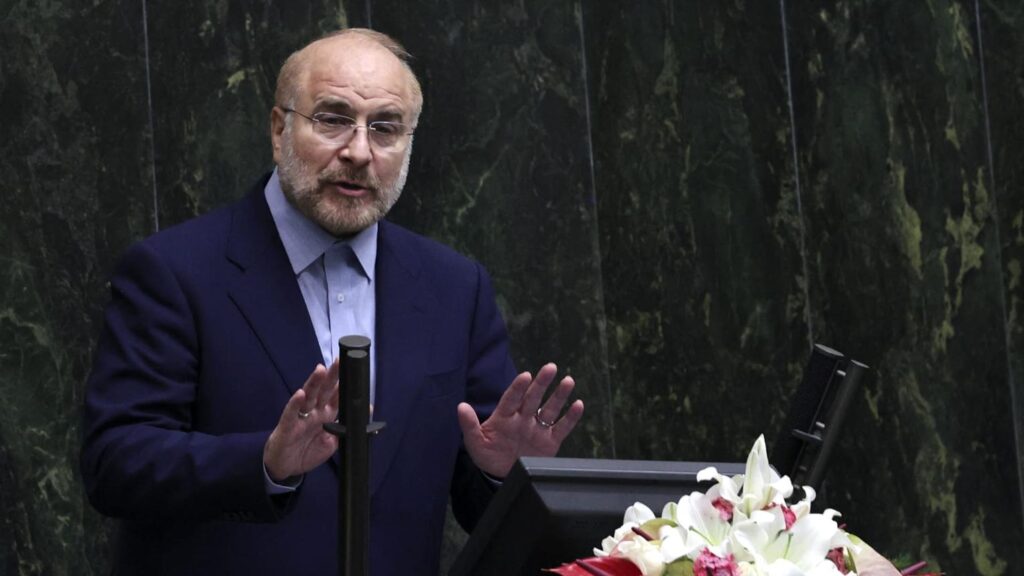
TEHRAN — Iran says neighbouring countries have sent Tehran “numerous messages” about creating new regional security arrangements and expanding economic cooperation, signalling that the prolonged US-Iran conflict may be accelerating a broader rethink of how Middle Eastern states protect themselves. Iranian Parliament Speaker Mohammad Bagher Ghalibaf said Saturday that an independent, locally built security order could provide lasting peace and stability, presenting greater regional autonomy as an alternative to heavy dependence on outside powers.
Ghalibaf did not publicly identify all the governments behind the messages or disclose whether formal negotiations on a new security framework have begun. His remarks nevertheless fit a diplomatic campaign Tehran has pursued since June, when Foreign Minister Abbas Araghchi proposed a security architecture built through cooperation among Gulf states themselves. Iran has increasingly argued that the region should develop mechanisms for collective security, economic integration and crisis management without allowing foreign military powers to determine the regional order.


The Iranian claim comes at an extraordinary moment of strategic realignment. Turkey has urged Washington to resume negotiations with Tehran and has offered support for mediation alongside Pakistan and Qatar, while Pakistan has maintained high-level contacts with Iranian leaders during efforts to revive diplomacy. At the same time, Saudi Arabia, Türkiye and Pakistan have moved closer through their own defence arrangements, demonstrating that regional states are increasingly experimenting with security structures that do not depend exclusively on Washington.
But any suggestion that a new cooperative regional order is already emerging should be treated cautiously. Relations between Iran and several Gulf governments remain deeply strained after months of warfare and attacks across the region. The UAE this week suspended trade and financial transactions with Iran following an alleged Iranian missile attack, while earlier Iranian threats against Gulf energy and desalination infrastructure intensified concerns among Arab governments. Tehran therefore faces a major credibility problem: countries may want a regional security mechanism while simultaneously regarding Iran itself as one of the threats that mechanism must contain.
The Changer Angle: The War May Be Changing Who the Region Trusts With Its Security
The bigger story is not simply that Iran wants another diplomatic forum. The Middle East may be entering a period in which states increasingly seek multiple overlapping security relationships instead of relying on one dominant external guarantor. The Saudi-Pakistan-Türkiye alignment, Turkish mediation, Pakistan’s diplomatic engagement with Tehran and Iran’s proposed Gulf framework point in different directions, but they share one important characteristic: regional capitals are attempting to create more room to manage their own security.
That does not mean the United States is disappearing from the region, nor does Ghalibaf’s statement prove that Iran’s neighbours have accepted Tehran’s proposed architecture. In fact, the identities of the governments sending the reported messages — and exactly what they proposed — remain crucial unanswered questions. A state discussing economic cooperation with Iran is not necessarily endorsing an Iranian-designed defence system.
The emerging shift may therefore be more complicated than a simple “US out, regional powers in” narrative. Saudi Arabia, Türkiye, Pakistan, Iran and the Gulf monarchies have different interests and relationships with Washington, Israel and one another. What appears to be developing is a more fragmented system in which countries maintain American relationships while simultaneously constructing regional partnerships, bilateral guarantees and alternative diplomatic channels.
For Iran, that creates both an opportunity and a contradiction. Tehran can argue that the war demonstrated the danger of depending on outside powers, but rebuilding a regional security order requires precisely what months of confrontation have damaged most: trust between Iran and its neighbours. Whether the messages described by Ghalibaf develop into negotiations will show whether the Middle East is merely discussing a new security architecture — or actually beginning to build one.