
By Shahnoor Saqib — The Changer
NEW DELHI, India, September 9, 2023 — India, the United States, Saudi Arabia, the United Arab Emirates and European partners have announced an ambitious economic corridor linking South Asia with the Middle East and Europe, unveiling plans for new transport, energy and digital connections during the Group of 20 summit in New Delhi on Saturday.
The proposed India–Middle East–Europe Economic Corridor, known as IMEC, is designed to improve commercial connectivity between major economic regions through a combination of maritime routes, railway infrastructure and supporting energy and communications networks.


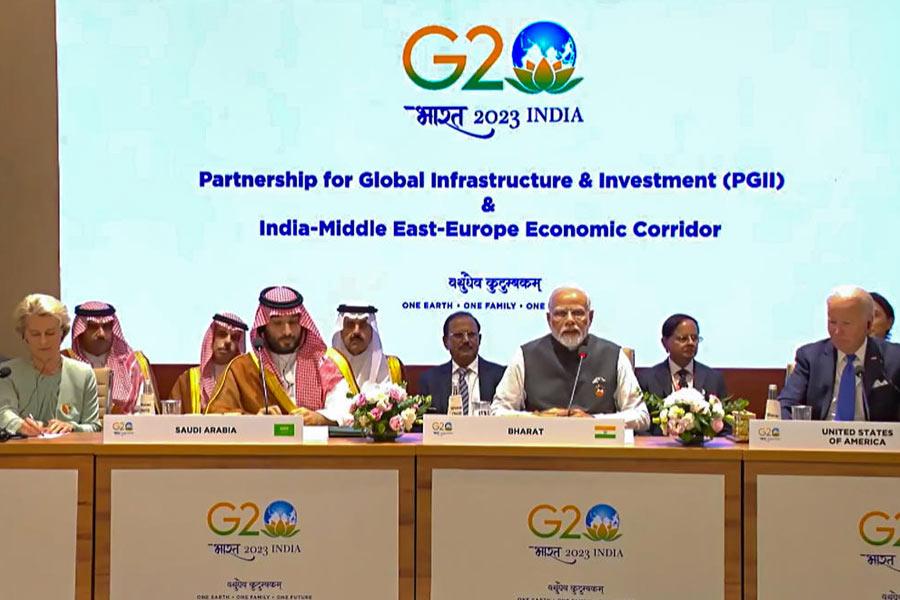
Indian Prime Minister Narendra Modi, US President Joe Biden and European Commission President Ursula von der Leyen joined leaders and representatives of partner governments for the announcement on the opening day of the summit, presenting the initiative as an important step toward stronger international trade and infrastructure cooperation.
The project brings together India, the United States, Saudi Arabia, the United Arab Emirates, the European Union, France, Germany and Italy under a memorandum of understanding setting out a framework for cooperation. The participating governments intend to develop a network that connects Indian ports with the Arabian Gulf and provides onward transport links through the Middle East to Europe.
The announcement forms part of a broader effort to expand infrastructure investment and improve the movement of goods across regions that play central roles in international manufacturing, energy supply and consumer markets.
The corridor is expected to consist of two main components. An eastern section would connect India with the Arabian Gulf, while a northern section would link the Gulf region with Europe. The planned system would combine shipping routes with railway connections intended to make cross-border freight movement more efficient.
The memorandum also envisages supporting infrastructure for electricity transmission, digital connectivity and clean energy development. Participating governments see the initiative as an opportunity to strengthen commercial integration while encouraging investment in transport systems and technologies needed for long-term economic growth.
The agreement establishes a framework for planning and cooperation rather than a completed transport network. The governments have not announced a comprehensive construction budget, binding completion date or finalized route covering every section of the proposed corridor.
The next stage requires participating countries to identify technical requirements, coordinate infrastructure priorities and develop implementation plans. Financing arrangements, construction schedules and regulatory agreements will be important factors in determining how quickly the proposal can advance.
For India, the corridor offers an opportunity to deepen commercial connections with Middle Eastern markets and European trading partners. Improved transport infrastructure could support exporters, manufacturers and logistics companies seeking more efficient access to international markets.
The initiative also highlights the growing economic importance of the Gulf region, where governments are investing in transport networks, industrial development and logistics facilities as part of wider economic diversification programmes.
Saudi Arabia and the United Arab Emirates occupy important positions in the proposed network because of their geographic location between Asia and Europe. Their participation could support the development of regional transport connections and associated investment in ports, railways and industrial infrastructure.
For European partners, the proposed corridor creates an opportunity to strengthen trade links with India and the Middle East while encouraging investment in diversified international supply chains.
The project is also attracting attention because of its potential strategic importance. Governments are seeking more resilient supply chains and additional transport options as geopolitical tensions, infrastructure constraints and disruptions to global trade increase the importance of reliable commercial routes.
China’s Belt and Road Initiative has already established a major presence in international infrastructure financing and construction. The newly announced corridor offers participating governments another framework for connectivity investment, although the memorandum does not formally identify China or its infrastructure programme as a target.
The planned route through the Middle East includes connections involving Jordan and Israel, according to the memorandum. While those countries are identified as part of the proposed transport network, neither is among the eight original signatories to Saturday’s agreement.
The inclusion of these connections highlights the importance of regional coordination. Establishing reliable cross-border railway services would require governments and infrastructure operators to address customs procedures, freight handling, technical standards, security requirements and the compatibility of national transport systems.
The corridor’s clean energy ambitions are also significant. Participating governments intend to explore infrastructure that could support the export of clean hydrogen, alongside electricity transmission and digital communications connections. These components could expand the project’s economic role beyond conventional freight transportation.
The European Commission says the initiative is intended to improve access to goods, energy and data while strengthening connections between European, Middle Eastern and Indian markets. Its proposed infrastructure includes rail and port links, energy facilities and telecommunications systems.
The agreement is linked to the Partnership for Global Infrastructure and Investment, an initiative supported by the United States and other partners to encourage infrastructure development and mobilize investment, particularly in low- and middle-income countries.
Modi and Biden co-chaired the G20 event at which the corridor was announced. Leaders and representatives from the European Union, France, Germany, Italy, Saudi Arabia, the United Arab Emirates and other participating organizations joined the discussions on infrastructure connectivity and investment.The memorandum calls for governments to work together on the technical, financial, legal and regulatory arrangements needed to establish the corridor. It also provides for coordinating bodies that can address practical challenges involving the proposed transit network.
The participating governments intend to meet within 60 days to develop an action plan with relevant timetables. The memorandum establishes political commitments but does not create legally binding obligations under international law.
Private investment is expected to be an important consideration as governments assess the scale of infrastructure required. New railway sections, upgraded ports, logistics facilities and cross-border energy connections could require substantial financing, while investors will need greater clarity on commercial demand, project costs and implementation arrangements.
For international businesses, the proposed corridor could create additional options for moving manufactured goods, agricultural products and industrial materials between major markets. Its potential benefits will depend on whether participating countries can establish competitive transport costs and dependable delivery arrangements.
The initiative could also encourage closer economic cooperation among countries whose trade relationships extend across the Indian Ocean, Arabian Gulf and Mediterranean region. Improved connections between ports, rail networks and commercial centres could support investment in manufacturing and distribution.
However, major questions remain about financing, construction, border procedures and the coordination of infrastructure across multiple jurisdictions. The announcement establishes a shared vision, but the commercial and logistical feasibility of individual projects still requires detailed assessment.
The corridor represents one of the most prominent infrastructure announcements on the opening day of the New Delhi summit. Its success will depend on whether the participating governments can translate Saturday’s memorandum into coordinated investment, operational transport links and lasting economic cooperation across Asia, the Middle East and Europe.