
THE CHANGER NEWS DESK
LAHORE, Sept 3 — Pakistan’s government and Jamaat-e-Islami agreed on Thursday to open formal negotiations over the petroleum levy and rising living costs, but the religious-political party refused a government request to suspend its protests, keeping pressure on Islamabad as consumers grapple with high fuel, electricity and food prices.
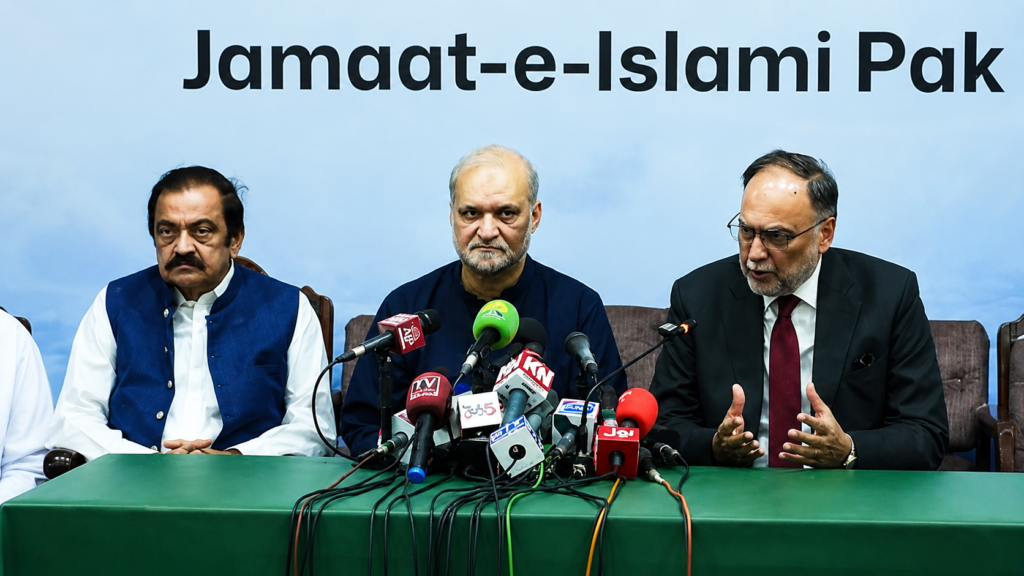
Planning Minister Ahsan Iqbal, Prime Minister’s Adviser on Political Affairs Rana Sanaullah and other government representatives met JI Emir Hafiz Naeemur Rehman and party leaders at Mansoorah in Lahore. Following the meeting, both sides announced they would establish expert committees to examine proposals aimed at reducing the petroleum levy and providing relief to consumers.


Iqbal said the government had formed its team and asked JI to establish a corresponding group of experts. He said Islamabad was prepared to examine workable recommendations for reducing the burden of the levy, while also presenting the government’s fiscal position during negotiations. Formal discussions are expected to begin on Monday, according to Business Recorder.
JI appointed Deputy Emir Liaquat Baloch to head its negotiating committee. The party is demanding the abolition of the petroleum levy, lower petrol prices, reductions in electricity tariffs and relief on essential food costs, while also raising objections over capacity payments associated with independent power producers.
The dispute has become increasingly significant as taxes and duties make up a substantial portion of Pakistan’s retail fuel price. Taxes and duties on petrol currently total about Rs114 per litre, including an approximately Rs80-per-litre petroleum levy, while diesel carries around Rs100 per litre in taxes and duties, according to figures reported on Thursday.
The confrontation is unfolding as fuel prices remain under pressure. Petrol rose by another Rs2.29 to Rs346.16 per litre effective Sept. 3, while high-speed diesel increased by Rs1.11 to Rs372.03 per litre, following volatility in international energy markets.
Hafiz Naeem said JI would continue its protest campaign even while negotiating with the government. The party’s sit-ins entered their 19th day on Thursday after beginning in provincial capitals in August and subsequently expanding to additional locations.
The government had sought a postponement of the sit-ins during negotiations, but JI rejected that request. Naeem argued that continued demonstrations would strengthen the negotiating process and reiterated that the party wanted immediate reductions in the petroleum levy and petrol prices.
Thursday’s nationwide shutter-down strike produced an uneven response. Markets and businesses closed in several areas of Sindh and Khyber Pakhtunkhwa, while commercial activity largely continued in much of Punjab and Balochistan. Some cities and districts reported more extensive closures, underscoring regional differences in support for the protest campaign.
Rana Sanaullah said the government was prepared to examine proposals presented by JI and that officials from the Finance Ministry, Federal Board of Revenue and Petroleum Ministry would participate in efforts to identify possible relief measures. He said workable recommendations could be implemented, while government officials have also pointed to international energy-market pressures as a major factor behind higher domestic prices.
The negotiations now shift the dispute from the streets to a parallel political and economic process, but no agreement has yet been reached on cutting or abolishing the petroleum levy. According to Sanaullah, the committees are expected to work toward a viable solution within two weeks.
For consumers, the outcome could have consequences beyond the petrol pump. Fuel costs feed directly into transportation and distribution expenses across the economy, making the petroleum levy one of the central issues in JI’s wider campaign over inflation and household expenses.
For the government, however, reducing the levy involves balancing demands for immediate consumer relief against revenue and fiscal commitments. That tension is likely to define the negotiations as JI attempts to maintain street pressure while simultaneously testing whether Islamabad is prepared to surrender part of a major fuel-tax revenue stream.