
By Naeema Saleem | The Changer
WASHINGTON — The Federal Reserve raised interest rates on Wednesday for the first time in more than three years, marking a sharp turn in U.S. monetary policy as persistent inflation persuaded policymakers that higher borrowing costs were necessary despite President Donald Trump’s repeated demands for rate cuts. The Federal Open Market Committee unanimously increased its benchmark federal funds rate by a quarter percentage point to a range of 3.75% to 4%, saying inflation remained elevated while economic activity continued to expand at a solid pace.
The decision represents more than a single adjustment in borrowing costs. After holding rates unchanged through its first five meetings of 2026, the Fed is signalling that controlling renewed price pressures has again become the dominant concern, even at the risk of making mortgages, credit cards, auto loans and business financing more expensive. Fed officials also indicated that further tightening could be necessary before the end of the year.


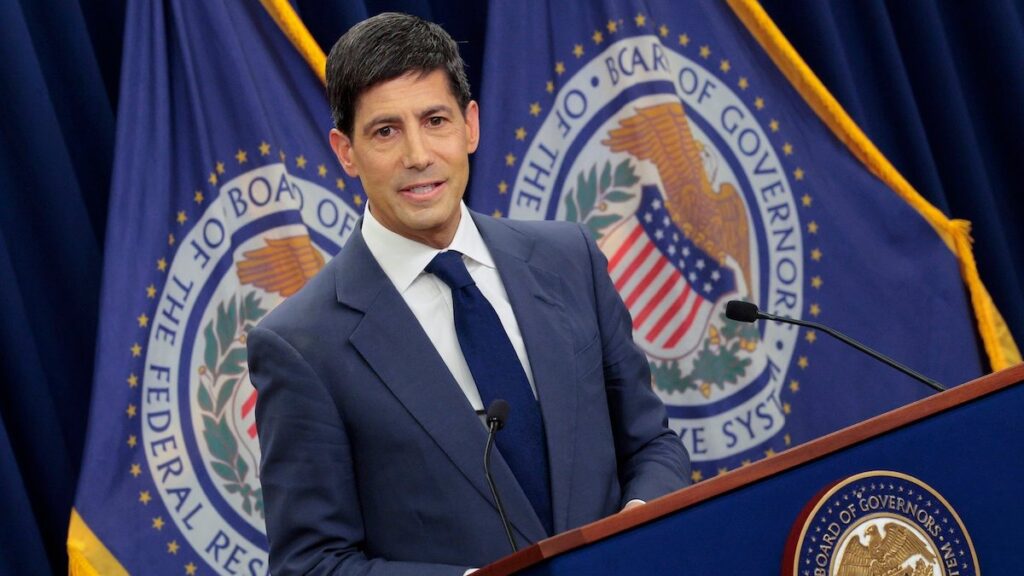
Fed Chair Kevin Warsh said inflation had remained too high for too long, while pointing to resilient consumer spending, robust capital investment and a labour market that has not deteriorated significantly. The central bank said job gains had kept pace with growth in the workforce and unemployment had changed little, giving policymakers greater room to focus on returning inflation toward the Fed’s 2% target.
Inflation has been complicated by a combination of domestic and international pressures. Higher energy costs associated with the Iran conflict have fed into prices, while tariffs and heavy investment connected to the artificial-intelligence boom have also contributed to inflationary pressure. The Fed’s preferred inflation measure was running at 3.7% in July from a year earlier, while core inflation stood at 3.3%, according to figures cited in reporting on Wednesday’s decision.
The move puts monetary policy in direct contrast with Trump’s publicly stated preference for substantially lower rates. After Wednesday’s announcement, Trump again called for the Fed to lower interest rates, continuing pressure he has applied to the central bank over borrowing costs. Warsh, whom Trump selected to lead the Fed, did not engage with the president’s criticism during his news conference and instead framed the decision around inflation and the central bank’s congressionally mandated objectives.
That contrast also underscores the institutional separation between the White House and the central bank. Presidents can nominate Federal Reserve governors and the chair, subject to Senate confirmation, but monetary-policy decisions are made by the FOMC. Wednesday’s 12-0 vote showed that the decision to raise rates was unanimous among voting policymakers rather than the product of an internal split over how to respond to inflation.
Financial markets reacted quickly. U.S. stocks reversed earlier gains and finished lower, while short-term Treasury yields rose and the dollar strengthened as investors absorbed the prospect that Wednesday’s increase may not be the last. The Dow Jones Industrial Average fell about 1.2%, the S&P 500 declined roughly 0.45% and the two-year Treasury yield climbed to about 4.74%.
For American households, the significance will depend on how long rates remain elevated and whether additional increases follow. The federal funds rate does not directly set consumer borrowing rates, but it influences financing conditions throughout the economy, meaning prolonged tightening can feed into credit-card rates, auto financing and other forms of borrowing. Mortgage rates are influenced heavily by longer-term Treasury yields and other factors, so they do not necessarily move point-for-point with a Fed decision.
The larger economic calculation facing the Fed is whether it can suppress inflation without unnecessarily weakening an economy that policymakers currently describe as resilient. Higher rates are intended to restrain demand and price increases, but keeping monetary policy tight for too long can also slow investment, consumer spending and hiring.
Wednesday’s decision therefore marks an important change in the direction of U.S. monetary policy. The Fed is no longer simply waiting for inflation to retreat while holding borrowing costs steady; it has begun tightening again and has left open the possibility of further increases if price pressures persist. That puts the trajectory of inflation — rather than political demands for cheaper money — at the centre of the next rate decision.