
By Naeema Saleem | The Changer
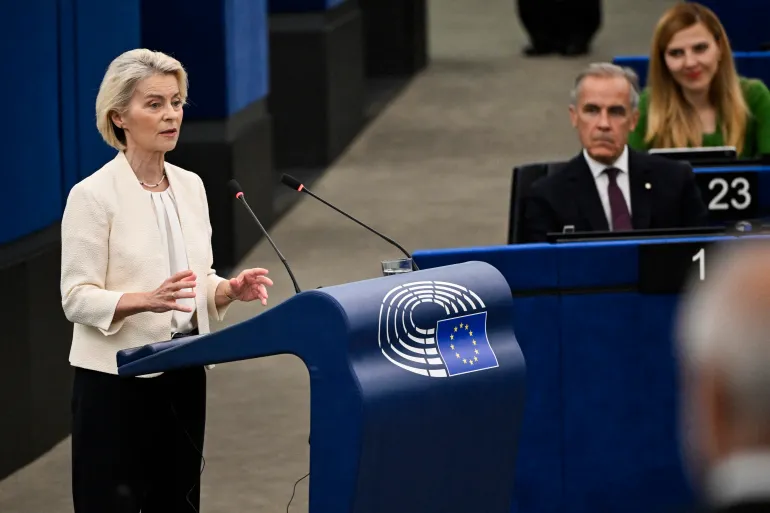
STRASBOURG, France — The European Union has offered Canada the possibility of becoming its first “associate member”, an unprecedented proposal that could reshape transatlantic economic and security ties as Ottawa seeks to reduce its heavy dependence on the United States following months of trade tensions with President Donald Trump’s administration. European Commission President Ursula von der Leyen unveiled the proposal on Wednesday during her annual State of the Union address, with Canadian Prime Minister Mark Carney attending in Strasbourg, saying Europe needed to rethink its partnerships in an increasingly hostile international environment.
Von der Leyen said she wanted to work with Canada on opening the door to the new status, drawing a standing ovation from European lawmakers. She argued that Canada and Europe shared interests ranging from artificial intelligence and climate policy to Arctic security, defence, critical raw materials and supply chains, while stressing their common support for democratic institutions. Carney welcomed the prospect of a significantly stronger alliance, although his office stopped short of explicitly accepting the proposed associate-member designation.


What “associate membership” would actually mean remains unresolved. No such formal category currently exists in the EU treaties, and von der Leyen did not set out legal rights, obligations or a timetable for creating it. Any substantive arrangement would also require support from EU member states, meaning Wednesday’s announcement should be viewed as the opening of a potentially significant negotiation rather than Canada formally being offered the rights of an EU member.
The proposal nevertheless represents a striking change in the direction of Canada’s foreign economic policy. Carney has said Canada is not seeking full EU membership but wants a “unique alliance” with Europe, as his government tries to diversify an economy that still sends roughly 70% of its exports to the United States. That effort has accelerated after Canada-U.S. trade negotiations broke down last month and the two countries imposed retaliatory tariffs.
Trump’s repeated statements about Canada potentially becoming the 51st U.S. state have added a sovereignty dimension to what might otherwise have remained primarily a trade dispute. Canadian officials have increasingly presented diversification toward Europe and other markets as a way to strengthen the country’s strategic autonomy rather than simply compensate for individual U.S. tariffs. Carney has pledged to double Canada’s non-U.S. trade over the next decade.
Europe and Canada already have much of the infrastructure needed to deepen that relationship. Their Comprehensive Economic and Trade Agreement, or CETA, provides an existing commercial foundation, while Canada this year became the first non-European country whose industry can participate under a bilateral agreement in procurement connected to the EU’s €150 billion Security Action for Europe, or SAFE, defence programme. Brussels and Ottawa have also been advancing cooperation on digital trade, critical minerals and economic security.
Von der Leyen indicated that the next stage could go considerably further. She proposed cooperation in advanced manufacturing and technology, greater integration of Canadian and European defence industries and a joint strategic focus on the Arctic. The two sides are expected to build on CETA through what has been described as an “Alliance for the Future”, aimed at creating a broader prosperity and economic-security relationship.
The initiative is therefore potentially more consequential than another free-trade agreement. Canada possesses energy resources, critical minerals, Arctic territory and an advanced industrial economy, while Europe offers a market of hundreds of millions of consumers and increasingly large defence and technology programmes. A framework connecting those assets could give both sides additional room to diversify supply chains at a time when economic security has become closely tied to geopolitical strategy.
There are, however, major questions before such an arrangement could become reality. EU governments would have to determine what privileges an associate member receives, whether participation could include elements of the single market or mobility rights, how much regulatory alignment would be required and whether Canada would gain any institutional role without becoming a full member. European diplomats and analysts have also cautioned that creating an entirely new category could raise questions for other close partners and countries seeking EU membership.
The political sensitivity was underscored by Trump’s response on Wednesday. The U.S. president criticised the possibility of Canada becoming an EU associate member and suggested Washington could respond with additional trade measures against Europe if it viewed the arrangement as directed against the United States. Von der Leyen, by contrast, explicitly described the proposed Canada partnership as being designed to strengthen the two sides rather than target another country.
The deeper shift is therefore not that Canada is about to join the European Union — it is not. Instead, two longstanding U.S. partners are exploring whether they can construct a new category of economic and strategic integration at a time when assumptions underpinning the transatlantic relationship are changing. The details of “associate membership” do not yet exist, but the fact that Brussels is prepared to invent such a framework for Canada shows how rapidly trade tensions and security concerns are altering relationships that once appeared fixed.
The next test will be whether the political symbolism can be converted into a workable agreement. Canada and the EU are preparing for their next summit in Canada on October 29-30, when the two sides will have an opportunity to define whether associate membership becomes a substantive new model of integration or remains primarily a declaration of closer partnership.