
World / South Asia | By Web Desk
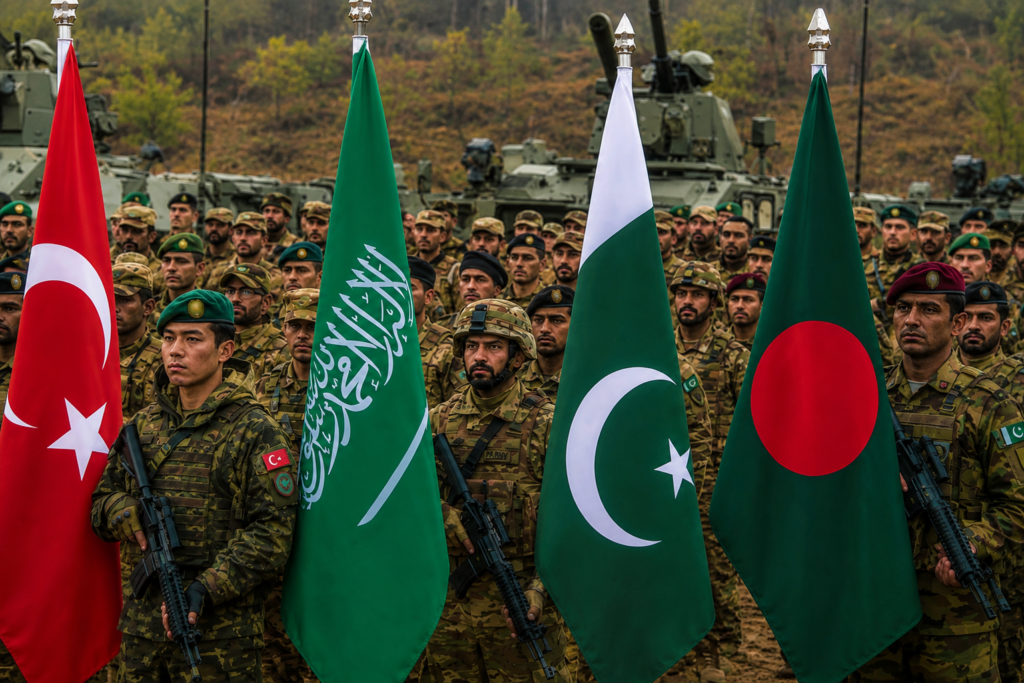
DHAKA — Bangladesh has signalled that it is open to joining the newly established Makkah Joint Defence Agreement between Pakistan, Türkiye and Saudi Arabia, a potentially significant development that could extend the emerging security framework from the Middle East into eastern South Asia. A senior aide to Bangladeshi Prime Minister Tarique Rahman said Dhaka would consider participation if joining such an arrangement served Bangladesh’s national interests, while stressing that no final decision has yet been made.
The three founding countries signed the agreement in Makkah on August 7, establishing a collective-defence commitment under which aggression against one member would be treated as aggression against all three. The pact brought together Pakistan’s military capabilities, Türkiye’s NATO-member armed forces and Saudi Arabia’s economic and strategic weight at a time when the Iran conflict has forced governments across the region to reassess traditional security relationships.


Bangladesh’s interest does not yet amount to a formal application or commitment to join. Dhaka’s position is better understood as keeping the option open while assessing how the new arrangement develops. Bangladesh has simultaneously been strengthening defence relations with Türkiye, with the two countries recently agreeing to establish a ministerial-level joint committee covering defence and foreign affairs. Relations with Saudi Arabia are also important because of energy, investment and the large Bangladeshi workforce in the kingdom.
Pakistan-Bangladesh relations form another important part of the equation. Dhaka has described its recent engagement with Islamabad as normal state-to-state diplomacy and has sought stronger trade and people-to-people contacts. The relationship remains historically sensitive because of the events surrounding Bangladesh’s independence in 1971, but the recent diplomatic trajectory shows both governments attempting to expand practical cooperation rather than allowing that history to define every aspect of the relationship.
For India, however, Bangladesh’s potential participation would carry much larger strategic implications. New Delhi said it was closely following developments when questioned about reports of Dhaka’s interest. Bangladesh shares a long border with India, meaning its entry would transform what began as a Pakistan-Saudi-Türkiye security arrangement into a framework with members positioned on both India’s western and eastern sides. That geographical reality is one reason the possibility is receiving considerable attention in Indian strategic circles.
The Changer Angle: Bangladesh Could Transform the Pact From a Three-State Agreement Into a Wider Security Architecture
The biggest story is not simply that Bangladesh may become a fourth member. Its accession would change the geographic character of the alliance. Pakistan connects the framework to South Asia, Saudi Arabia anchors it in the Gulf and Türkiye extends it toward Europe and the Mediterranean. Bangladesh would give the grouping a significant presence on the Bay of Bengal and introduce an eastern South Asian dimension.
That would also test what the Makkah agreement ultimately intends to become. If membership remains limited to the three founding states, it can be viewed primarily as a strategic mutual-defence arrangement responding to Middle Eastern instability. If Bangladesh joins — and other countries subsequently seek membership — the agreement begins looking much more like the foundation of a broader multinational security bloc. Analysts have already discussed other possible participants, including Egypt, although no wider expansion has been confirmed.
There is another important distinction. Bangladesh strengthening relations with Pakistan does not automatically mean Dhaka is choosing Islamabad over New Delhi. Bangladesh maintains deep geographic and economic links with India while simultaneously expanding ties with Pakistan, Türkiye, Saudi Arabia and other partners. Its emerging approach appears closer to strategic diversification — building multiple relationships so that no single external power dominates its foreign-policy options.
That is why Dhaka’s eventual decision will matter well beyond Bangladesh. The Makkah pact was created only weeks ago as a three-country mutual-defence agreement. If Bangladesh becomes its first new member, the more consequential signal may be that the pact is no longer merely an agreement among three governments — it has begun attracting countries from outside its original core.