
By The Changer Pakistan Desk
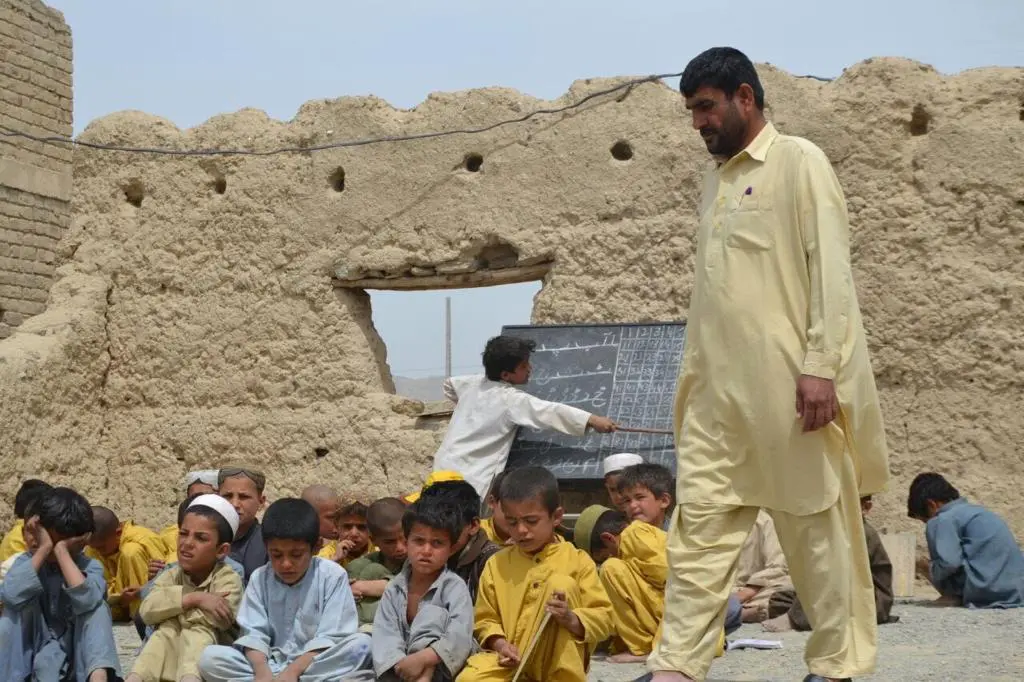
QUETTA, Sept 8 — Balochistan has spent more than Rs300 billion on education over the past two years and says hundreds of thousands of children have been brought into the education system. Yet one figure exposes why money alone has struggled to transform the province: of roughly 23,000 settlements, only about 12,000 have access to schooling facilities, according to educationist Nazar Khan Barech.
That means the central problem is not simply Balochistan’s low literacy rate. In thousands of scattered communities, the education system is still confronting something more fundamental — the physical absence of a nearby school.


The contrast is particularly striking on International Literacy Day. Chief Minister Sarfraz Bugti said Tuesday that his government had reactivated more than 3,800 inactive schools, brought 768,000 out-of-school children back into the education system and established more than 2,000 new schools through the Balochistan Education Foundation. Another 1,800 schools and 3,000 additional classrooms are planned, he said.
Those figures point to substantial intervention rather than inactivity. But they coexist with an education geography that remains exceptionally difficult to overcome.
Balochistan covers about 347,190 square kilometres, making it Pakistan’s largest province territorially while supporting a relatively dispersed population. The enormous distances between communities mean that conventional education spending can improve existing schools without necessarily solving the access problem facing settlements where schools do not exist at all.
The problem is not new. Balochistan’s own Education Management Information System has previously acknowledged that roughly 40% of settlements were without a school facility, while also documenting major infrastructure deficiencies among existing schools.
This is where the province’s education debate becomes more complicated than the headline comparison between billions spent and literacy achieved.
Pakistan’s latest Economic Survey says Balochistan has made progress in reducing educational exclusion, with the estimated proportion of out-of-school children falling from 69% in 2023 to 45% in 2025. Meanwhile, reporting based on Pakistan Bureau of Statistics figures puts the province’s literacy rate at about 49%, up from 43% five years earlier.
But provincial averages conceal extraordinary differences inside Balochistan. Kech’s literacy rate is reported at about 63%, compared with just 21% in Washuk. In Dera Bugti, the home district of the chief minister, overall literacy is reported at 24%, with female literacy at only 10%.
That suggests Balochistan does not have one education crisis. It has several overlapping ones: children who have never had reasonable physical access to a school, schools that exist but lack adequate infrastructure, children who enrol but later drop out, gender barriers, teacher availability and the separate question of whether children attending school are actually learning.
Recent programmes demonstrate that targeted intervention can produce results. A five-year European Union-funded programme implemented with the Balochistan government and UNICEF said more than 760,000 children benefited from expanded learning opportunities and strengthened education systems, including nearly 335,000 girls. The EU provided €17.4 million for the programme between 2021 and 2026.
The province is also experimenting with alternatives to the conventional school model. Pakistan’s Non-Formal Education Management Information System listed 2,820 non-formal primary schools in Balochistan as of September 7, alongside middle-level and adult-learning facilities.
These alternatives matter because building a traditional government school in every small and isolated settlement across a province larger than many countries may be financially and administratively difficult. Community schools, accelerated learning centres, mobile or technology-supported education and strategically located school clusters therefore become part of the access equation rather than peripheral projects.
The challenge is to distinguish expenditure from actual educational reach.
A rupee spent repairing an existing urban school, paying salaries or constructing additional classrooms is legitimate education spending. But it does not automatically shorten the distance between a child in an isolated settlement and the nearest functioning classroom. Balochistan can therefore simultaneously increase its education budget, reactivate thousands of schools and still leave enormous geographic gaps in access.
That is the contradiction at the centre of the province’s literacy problem.