
By Shayan Najeeb — The Changer
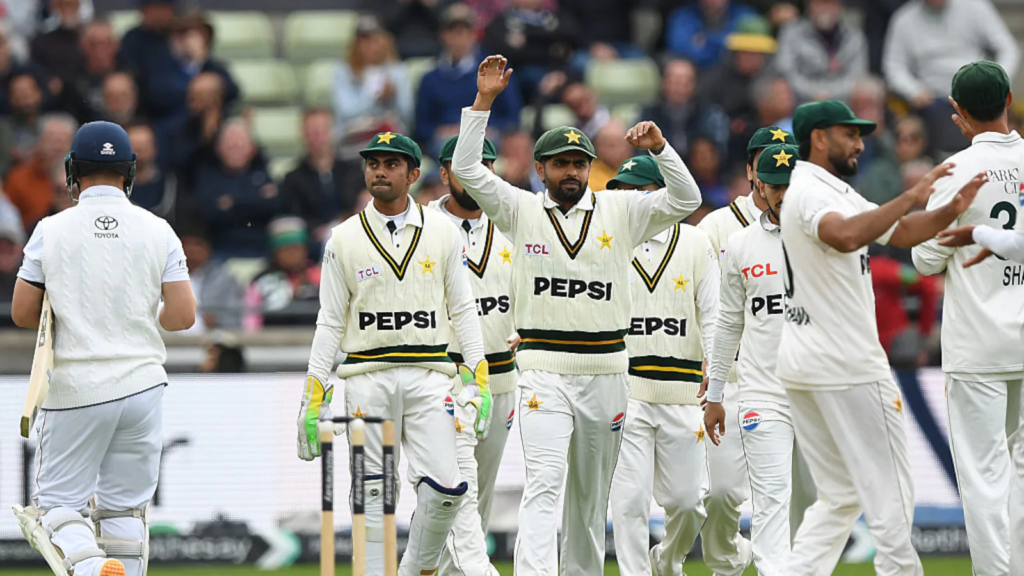
BIRMINGHAM, England, Sept 12 — Babar Azam said he remained confident of continuing as Pakistan’s Test captain after England completed a 3-0 series whitewash at Edgbaston on Saturday, but the scale of Pakistan’s defeat has left him facing a problem considerably larger than defending his own position. Pakistan finished the tour having lost 16 of their last 21 Tests, while seven members of the original squad had already been sent home and head coach Sarfaraz Ahmed and bowling coach Umar Gul removed before the final match, leaving Babar to lead a side that was effectively being reconstructed while the series was still being played. England completed the sweep with an eight-wicket victory after Joe Root made an unbeaten 62 and Jordan Cox 59 not out in a chase of 130, sealing England’s first Test series victory in 19 months and Pakistan’s latest descent in a prolonged red-ball decline.
Pakistan did finally show resistance at Edgbaston, but only after another first-innings collapse had left the match heavily tilted towards England. The tourists were dismissed for 133 after being reduced to 26-4 inside the opening hour, continuing a series in which their batting repeatedly failed against England’s pace attack. They then conceded a first-innings deficit of 320 before mounting their strongest batting response of the tour, with debutant Razaullah producing a remarkable 81 from 63 balls as Pakistan stretched the contest into a fourth day. England briefly stumbled when Mohammad Abbas removed Ben Duckett and Emilio Gay in the opening over of the chase, but Root and Cox extinguished any prospect of an unlikely comeback. Ollie Robinson finished the series with 21 wickets and was named player of the series, while Root’s unbeaten half-century completed a successful return to the England captaincy following Ben Stokes’ retirement.


For Pakistan, however, the final scoreline tells only part of the story. The tour began with an innings-and-103-run defeat at Headingley and a 194-run loss at Lord’s, results severe enough for the Pakistan Cricket Board to intervene before the series had even finished. Mohammad Rizwan, Imam-ul-Haq and Salman Ali Agha were among seven players released from the squad, while Sarfaraz and Gul were removed from the coaching staff. Mike Hesson and Ashley Noffke were brought into the backroom team and Pakistan summoned a replacement group containing five players without Test experience. Former Pakistan coach Jason Gillespie publicly criticised the upheaval as another sign of instability around the national side.
The most consequential detail for Babar’s leadership is that the captain himself said the overhaul surprised him. Before the Edgbaston Test, Babar revealed that the decision to remove Sarfaraz and send seven players home was “news” to him, with the wholesale changes having been planned outside the dressing room by the national selection panel. That creates an unusual backdrop to his insistence after Saturday’s defeat that he remains confident of leading Pakistan. The question is no longer simply whether the PCB continues to trust Babar as captain; it is how much authority a Test captain actually possesses when selectors can substantially reconstruct his squad and coaching structure in the middle of an overseas series.
Babar acknowledged that Pakistan had to conduct a serious review, saying the team needed to examine its mistakes and settle on the players and combinations capable of taking the Test side forward. His assessment was difficult to dispute. Pakistan’s batting was repeatedly overwhelmed in England, while even the final Test illustrated the depth of the problem: the same side capable of fighting back strongly in its second innings had already surrendered a 320-run first-innings deficit. Babar said Pakistan had enjoyed some good moments and bowled well in periods, but admitted that soft dismissals in the first innings had proved costly. He also argued that exposure to high-quality opposition could benefit the younger players introduced during the upheaval.
Those younger players provide the PCB with at least one argument that the disastrous tour produced something usable. Razaullah, one of three Pakistan debutants at Edgbaston, dismissed Root with only his fourth delivery in Test cricket before producing the extraordinary counterattacking 81 that temporarily prevented England from wrapping up the match on Friday. His emergence, alongside opportunities given to other inexperienced players, offers Pakistan a possible foundation for October’s assignment against Sri Lanka. But throwing young players into a team after senior players and coaches have been removed mid-tour is very different from implementing a planned generational transition, and Pakistan must now determine whether the Edgbaston selection represented the beginning of a coherent rebuild or an emergency reaction to two heavy defeats.
That distinction matters because Pakistan’s Test crisis predates this tour. The 16 defeats in their last 21 Tests cited by Reuters demonstrate that England did not create the problem; the whitewash exposed its depth. Repeated changes in coaching, selection and personnel have accompanied the deterioration, and the latest intervention has again shifted responsibility among captain, selectors, coaches and administrators. The PCB’s mid-series decisions may ultimately prove justified if the replacement players develop into a stronger side, but they also leave a basic governance question unresolved: if the captain was not central to decisions that transformed his own touring party, it becomes harder to determine who should ultimately be held accountable for the results of the team that emerges.
England’s contrasting position makes Pakistan’s instability even more conspicuous. The hosts also entered the series amid transition after defeats by New Zealand and in the Ashes, with Root returning to the captaincy and interim red-ball coach Marcus Trescothick preparing to hand over to Stephen Fleming before the winter tour of South Africa. Yet England used the Pakistan series to establish momentum rather than trigger another restructuring. Robinson led a pace attack containing Jofra Archer, Josh Tongue and Gus Atkinson that repeatedly exposed Pakistan’s batting, while Root’s experience provided stability when England lost two wickets without scoring at the start of Saturday’s chase. England still have batting questions of their own, but they leave the series with a settled victory and identifiable selection choices rather than an institutional argument about who controls the team.