
By Tabassum Ranjha — The Changer
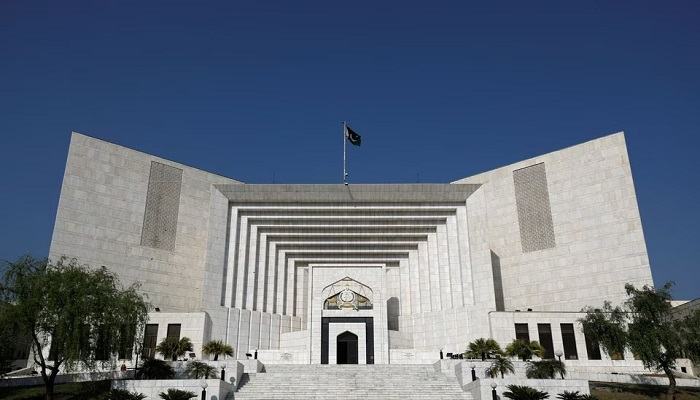
ISLAMABAD, October 13, 2026 — Pakistan’s Supreme Court has upheld the death sentence of a man convicted of murdering a woman after she rejected his marriage proposal, delivering a significant judgment that challenges patriarchal attitudes and reinforces women’s right to choose whether and whom to marry. The ruling goes beyond the individual criminal case, addressing traditional practices that place family honour, male authority and social pressure above a woman’s consent. It also establishes a forceful judicial rejection of the argument that romantic rejection can justify violence or reduce criminal responsibility.
A three-member bench comprising Justice Muhammad Hashim Khan Kakar, Justice Salahuddin Panhwar and Justice Ishtiaq Ibrahim dismissed a review petition filed by Muhammad Kamran, who had been convicted of murdering Maimoona Shaheen. The prosecution’s case was that Kamran shot and killed the woman at her home after she and her family refused his marriage proposal. His conviction and capital sentence had previously been upheld by the higher courts, and the latest proceedings concerned whether there were grounds to reconsider the punishment.


In its judgment, authored by Justice Kakar, the court condemned the social attitudes that treat a woman’s refusal as an injury to a man’s honour or personal standing. It observed that marriage requires the free consent of both individuals and that no person has an automatic entitlement to another person’s affection or agreement. The judges rejected the suggestion that anger, humiliation or disappointment following rejection could provide a legally acceptable explanation for murder.
The court’s reasoning places individual autonomy at the centre of the dispute. Rather than treating the case solely as a question of punishment, the judgment examined the beliefs that can turn a rejected marriage proposal into threats, coercion or deadly violence. It identified the assumption that women can be claimed or controlled by men as a central problem underlying such offences.
Kamran had sought the commutation of his death sentence to life imprisonment, referring in part to the approximately 14 to 15 years he had already spent in custody. The Supreme Court rejected the argument that time served on death row automatically entitled a prisoner to the legal treatment of someone sentenced to life imprisonment. It emphasised that the nature of the original sentence and the requirements governing judicial review could not be disregarded simply because a substantial period had passed.
The judgment also examined several customary practices associated with coercive marriage arrangements, including ghag, swara and watta-satta. The judges discussed how these traditions, although different in their operation, can undermine a woman’s ability to make independent decisions about marriage. The court’s criticism was directed at the coercive features of such practices and the social attitudes that allow women’s wishes to be subordinated to those of families, tribes or prospective husbands.
Ghag, historically associated with parts of Khyber Pakhtunkhwa, involves a man’s unilateral declaration of a claim to marry a woman, sometimes accompanied by intimidation intended to discourage other prospective suitors. The court noted that the practice has already been criminalised under provincial legislation. Its discussion illustrated how coercion can restrict a woman’s choices even when no lawful marriage has taken place.
The judgment also referred to swara, sometimes called vani, under which girls or women may be given in marriage as compensation to settle disputes between families. Such arrangements have been targeted by criminal legislation because they treat marriage as a means of resolving conflict rather than a voluntary relationship. The court additionally considered watta-satta, a reciprocal marriage arrangement, as an example of how family decisions may sometimes override the interests and wishes of the individuals involved.
These observations carry significance beyond the criminal appeal because legal prohibitions alone do not necessarily eliminate deeply rooted social practices. Effective protection depends on whether police, prosecutors, local authorities and courts respond when women face threats or coercion over marriage decisions. The judgment strengthens the judicial language available to challenge such conduct, although its practical impact will depend on enforcement and the handling of future cases.
The Supreme Court also connected its reasoning to religious and international legal principles. It stated that Islam recognises a woman’s free consent as a prerequisite for marriage and that the decision to marry belongs to the individuals concerned. The judgment further referred to Pakistan’s obligations under the Convention on the Elimination of All Forms of Discrimination Against Women, which recognises equal rights in choosing a spouse and entering marriage voluntarily.
The ruling reflects a wider challenge confronting Pakistan’s justice system: how to protect women from violence motivated by perceived dishonour, rejected proposals or disputes over personal autonomy. Criminal punishment addresses offences after they occur, but preventing such violence also requires timely responses to harassment, stalking, intimidation and threats. The court’s observations provide a legal and moral framework for recognising these behaviours as warning signs rather than dismissing them as private family disagreements.
The decision should not be interpreted as creating an entirely new criminal offence or automatically invalidating every traditional marriage arrangement. Its immediate legal effect is to dismiss Kamran’s review petition and leave his death sentence in place. Its wider importance lies in the Supreme Court’s explicit recognition that women’s consent is indispensable and that refusal cannot be converted into an excuse for violence.
For women’s rights advocates and legal practitioners, the judgment provides a clear statement from Pakistan’s highest court that personal autonomy cannot be sacrificed to social custom or wounded pride. Whether that principle translates into greater protection will depend on the willingness of institutions to intervene before coercion escalates into serious violence. The ruling makes clear, however, that a woman’s decision to reject a marriage proposal is a right to be respected, not an act that can diminish the responsibility of someone who responds with violence.