
By Sadaf Sundas Riaz — The Changer
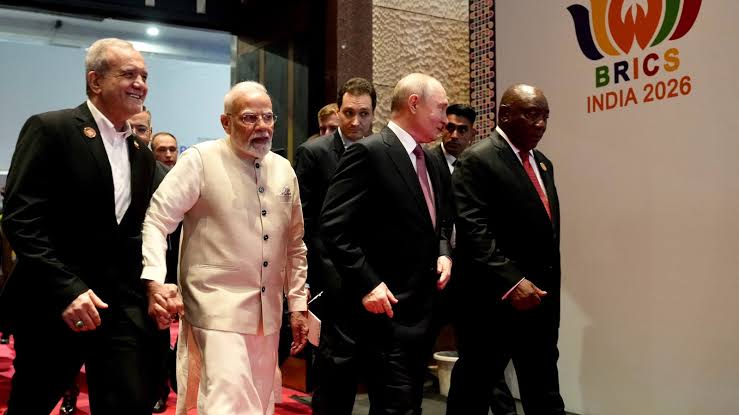
NEW DELHI, Sept 12 — Iran and the United Arab Emirates backed a joint BRICS declaration calling for maximum restraint in the Middle East war on Saturday and held their highest-level talks since the conflict began, giving the expanded bloc a rare diplomatic opening between two members whose wartime confrontation had previously helped frustrate consensus. Iranian President Masoud Pezeshkian met Abu Dhabi Crown Prince Sheikh Khaled bin Mohamed bin Zayed Al Nahyan on the sidelines of the New Delhi summit, where the two sides discussed de-escalation, regional stability and prospects for peace and development. The encounter did not produce a ceasefire initiative or announce a settlement of their disputes, but paired with the unanimous BRICS declaration it marked a significant change from earlier months, when tensions between Tehran and Abu Dhabi had exposed how the Middle East war could fracture the very grouping seeking a larger role in global affairs.
The New Delhi Declaration expressed deep concern over escalating Middle East hostilities, urged “maximum restraint” and reaffirmed that international disputes should be addressed through dialogue, consultation and diplomacy. It also called for protection of civilians and civilian infrastructure, stressed nuclear safety and security and warned against disruptions to international trade and energy flows. The formulation was carefully constructed to preserve consensus among members with sharply different relationships to Iran, the United States and Gulf security architecture: rather than assigning responsibility for the war in language that would have been unacceptable to some members, BRICS acknowledged differing national positions while establishing a common minimum around de-escalation. The diplomatic achievement was therefore not the toughness of the declaration but the fact that Iran and the UAE could sign the same document at all while the U.S.-Iran war and its regional consequences continue.


That consensus gives New Delhi something it did not have earlier in the crisis. BRICS has expanded rapidly beyond Brazil, Russia, India, China and South Africa, adding major Middle Eastern and emerging economies, but enlargement has imported regional rivalries directly into the organization. The presence of Iran and the UAE made the Gulf conflict an internal BRICS problem as much as an external foreign-policy issue, and diplomats entered the summit facing the possibility that disagreement over the war would expose the limits of the bloc’s ambition to speak for the Global South. Instead, Saturday’s declaration showed that expansion can also create an unusual diplomatic mechanism: countries divided outside BRICS can be compelled inside it to negotiate language they can jointly defend. Reuters reported that bridging differences between Iran and the UAE was among the summit’s central tests.
The Pezeshkian-Sheikh Khaled meeting makes that institutional development more consequential. According to the UAE account, the two discussed regional and international issues and the need to support efforts to ease tensions and strengthen stability. It was their highest-level engagement since the war began and came against a backdrop of severely strained relations following Iranian attacks on U.S. facilities in the UAE during the conflict. Their meeting should not be portrayed as reconciliation: neither government announced restoration of strategic trust, a bilateral security arrangement or an agreement resolving their wartime grievances. What emerged instead was a political channel through which two governments with immediate security disputes could speak directly while simultaneously accepting the same multilateral call for restraint.
For India, that distinction matters. Prime Minister Narendra Modi has sought to position BRICS not as an explicitly anti-Western alliance but as an institution capable of giving emerging economies greater influence over global governance, even as Russia and China push more forcefully for alternatives to Western-led political and financial structures. The Middle East war offered a difficult test of that proposition because New Delhi maintains major relationships across virtually every side of the regional divide: strategic ties with Washington and Israel, longstanding links with Tehran and increasingly deep economic, energy and security relationships with the Gulf Arab states. Modi separately met Sheikh Khaled on Saturday, with the two sides discussing defence, artificial intelligence, critical minerals, energy, food security and connectivity — illustrating how India’s Gulf diplomacy now extends well beyond traditional oil relationships.
China, meanwhile, used the summit to push BRICS toward a more active diplomatic role in the conflict. President Xi Jinping argued that the war was contrary to the interests of BRICS members and called for greater efforts to promote peace in the Gulf and wider Middle East. Iran itself pressed the bloc in another direction, with Pezeshkian calling for stronger resistance to unilateral sanctions, deeper financial cooperation outside what Tehran regards as monopolistic structures and creation of a permanent BRICS secretariat. Those positions reveal why Saturday’s consensus should not be mistaken for strategic unity: China, India, Iran, the UAE, Russia and other members continue to approach the international order from substantially different starting points. Yet a bloc does not need identical foreign policies to become diplomatically useful; it needs enough institutional leverage to prevent those differences from repeatedly making collective action impossible.
That may be the more important consequence of the New Delhi summit. BRICS was originally built around economic coordination among large emerging economies, but its enlargement has placed governments involved in some of the world’s most difficult geopolitical disputes inside the same political framework. This creates an obvious weakness because consensus becomes harder as membership diversifies, but it also creates something traditional alliances cannot easily replicate: a negotiating room containing governments that do not necessarily share allies, security guarantees or interpretations of a conflict. Iran and the UAE sitting inside the same bloc during a war that has directly damaged their relationship demonstrates both sides of that transformation. The disagreement could have paralysed BRICS; instead, for at least one declaration and one high-level meeting, BRICS became the venue through which the disagreement was managed.
The declaration also ties de-escalation to economic security. BRICS members warned about threats to international trade, supply chains and energy flows as Middle East fighting raises shipping risks and energy prices, concerns that matter acutely to both Asian importers and Gulf exporters. The organization also criticised unilateral tariff and non-tariff measures and sanctions not authorised by the U.N. Security Council, extending the summit beyond immediate battlefield diplomacy into the broader argument over how much influence Washington should wield through sanctions, trade restrictions and the dollar-based international financial system. India nevertheless avoided turning the gathering into a straightforward anti-U.S. platform, underscoring the internal balancing act that will determine whether BRICS develops into an alternative geopolitical pole or remains a looser coalition seeking reform of the existing order.