
By Sadaf Sundas Riaz — The Changer
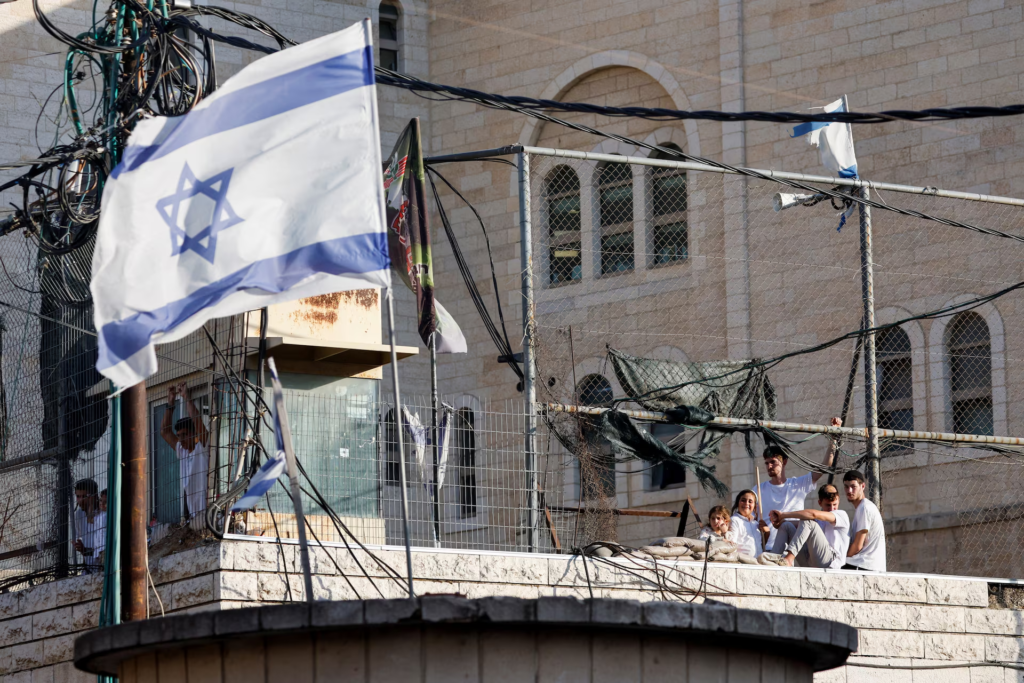
LONDON/PARIS/OTTAWA, Sept 8 — Britain, France and Canada moved on Tuesday to ban trade in goods from Israeli settlements in the occupied West Bank, turning years of diplomatic criticism into coordinated economic action as settlement expansion and violence deepen fears that a two-state solution could become geographically impossible. China, meanwhile, has continued to emphasize dialogue and political settlement in the wider Middle East crisis, highlighting an increasingly visible divide in how major powers are trying to influence the region.
The three Western governments said they would introduce national measures prohibiting settlement goods, while a broader group including Denmark, Finland, Iceland, Ireland, Norway, Poland, Portugal, Spain and Sweden either backed European restrictions or said they were considering additional measures. Their joint statement said settlement expansion, rising settler violence and Israel’s decision to advance the E1 project were rapidly undermining prospects for two states.


The measures are economically limited but diplomatically significant. Agricultural goods such as dates, citrus fruit, herbs and wine produced in settlements represent only a small fraction of Israel’s exports, meaning the immediate effect on overall Israeli trade is likely to be modest. Their importance lies instead in the precedent: three major Western economies are beginning to attach tangible commercial consequences to settlement policy rather than relying primarily on diplomatic condemnation.
That distinction makes Tuesday’s announcement potentially more important than its trade value suggests.
Britain, France and Canada said the measures were intended to protect the viability of a Palestinian state and oppose steps they regard as amounting to annexation or forcible displacement. They simultaneously reaffirmed Israel’s legitimate security interests, condemned Hamas’s October 7 attack and said their objective remained a secure Israel alongside a sovereign and viable Palestinian state.
The E1 settlement project is central to that concern. Situated east of Jerusalem, its development has long generated international opposition because construction there could severely disrupt territorial continuity between Palestinian population centres in the West Bank. Israel announced plans for another 1,000 West Bank homes on Tuesday as international pressure intensified.
Israel responded forcefully.
Foreign Minister Gideon Saar announced the closure of Britain’s consulate in East Jerusalem, which is accredited to the Palestinian Authority, and said Britain would be removed from a U.S.-led Gaza coordination mission. Israel also barred several British figures from entering the country. Saar described London’s measures as interference in Israeli sovereignty and its approaching election, while President Isaac Herzog similarly accused Britain of electoral interference.
The confrontation therefore crossed another threshold: settlement policy is no longer producing only diplomatic statements. It is beginning to reshape bilateral relationships, trade policy and diplomatic representation.
Britain went further than the settlement-import prohibition. Foreign Secretary Ed Miliband announced additional sanctions against extremist settlers and said Britain would refuse licence applications for arms and other exports that materially contribute to the occupation, extending restrictions already imposed on licences connected with military operations in Gaza.
France cited what it called the rapid expansion of settlements and increasing violence in explaining its action, while Canada reiterated that settlement growth undermines the two-state outcome it regards as essential to both Palestinian aspirations and Israel’s long-term security.
The widening coalition is equally important. The joint foreign ministers’ statement involves 12 countries, while Ireland, Spain, the Netherlands, Norway and Belgium were specifically cited for measures already taken. An EU-wide response, however, remains difficult because member states remain divided over policy toward Israel.
Washington is taking a different position. U.S. Secretary of State Marco Rubio said the United States would not join Britain, France and Canada in blocking settlement imports and warned that sanctions could destabilize the West Bank.
That leaves an increasingly fragmented diplomatic landscape around Israel and the Palestinians.
China has sought to position itself differently in the wider Middle East crisis, emphasizing negotiation, regional autonomy and opposition to outside interference rather than joining the Western sanctions architecture. President Xi Jinping reinforced that approach during his recent diplomacy in Cairo, where Beijing’s expanding economic and political engagement has also underscored China’s attempt to present itself as a major regional partner.
The difference should not be overstated: China, Europe, Canada and the United States are pursuing policies shaped by different interests, alliances and disputes, and Beijing’s calls for dialogue do not constitute a direct equivalent to the Western settlement measures.
But together they reveal a broader transformation.