
By Sadaf Sundas Riaz — The Changer
ISLAMABAD, Sept 8 — Five of Pakistan’s biggest cities sit among the world’s 10 least climate-resilient major urban centres, but the ranking exposes a problem deeper than extreme weather: Pakistan’s cities are entering an era in which inadequate adaptation could increasingly translate climate exposure into damaged infrastructure, disrupted businesses, falling asset values and growing public liabilities.
Hyderabad, Multan, Lahore, Faisalabad and Karachi all appear in the bottom 10 of a 72-city assessment produced by geospatial analytics company AlphaGeo. Hyderabad and Multan rank second and third least resilient respectively, Lahore fifth, Faisalabad seventh and Karachi eighth, according to reporting on the index published on Tuesday.


Yet the underlying AlphaGeo study was not released on September 8. The company’s original report, How Climate Resilient Are the World’s Largest Cities?, was published on March 25, 2026 and has gained renewed attention this week. That distinction matters because the study measures something more sophisticated than which cities simply experience the most floods or heatwaves.
AlphaGeo’s Climate Risk & Resilience Index separates a city’s physical climate risk from its resilience-adjusted risk, or RAJ — essentially asking how much danger remains after local adaptation measures are taken into account. Its assessment incorporates six physical hazard layers, including inland and coastal flooding, heat stress, drought, wildfires and hurricane winds, then overlays local adaptation capacity.
That produces one of the report’s most consequential findings for Pakistan: geography is not destiny. AlphaGeo found that cities with almost identical physical-risk profiles can end up as much as 33 RAJ points apart because of differences in adaptation. In other words, exposure to extreme climate conditions does not by itself determine the eventual damage; infrastructure, governance and investment can materially change the outcome.
For Pakistan, that distinction is uncomfortable. Hyderabad recorded a RAJ score of 41, tying India’s Ahmedabad for the highest residual climate risk in the analysis. Multan scored 38, Lahore 35, Faisalabad 34 and Karachi 32. Six of the highest-risk cities — Ahmedabad, Hyderabad, Multan, Dhaka, Kolkata and Lahore — are concentrated in South Asia.
Extreme heat is a major component of that South Asian vulnerability. But Pakistan’s urban exposure is multidimensional: Karachi combines heat with coastal and inland flooding risks, while inland cities face combinations of heat stress, water pressure and flooding. AlphaGeo cautions that its scores are city-wide averages and that risks can differ significantly from one neighbourhood or street to another.
This is where the ranking becomes more than another international climate league table.
For governments, high residual climate risk can eventually mean larger disaster-response costs, repeated infrastructure repairs and pressure created by displacement. For investors and property owners, AlphaGeo argues that high RAJ scores warrant scrutiny because climate exposure can affect property values, infrastructure lifespans and continuity of operations. Recent reporting on the study specifically identifies Bangladesh and Pakistan as countries deserving attention because high urban residual risk is colliding with limited capacity to close the adaptation gap quickly enough.
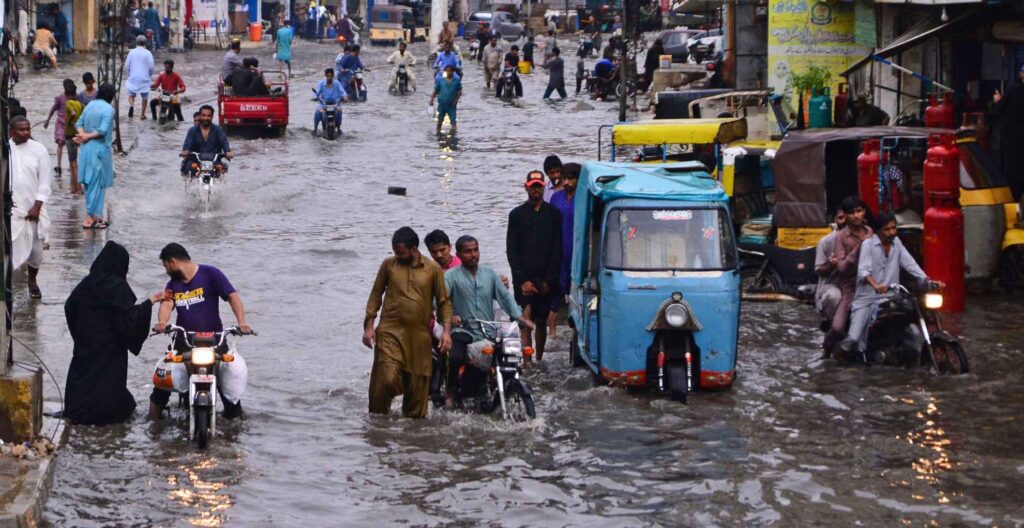
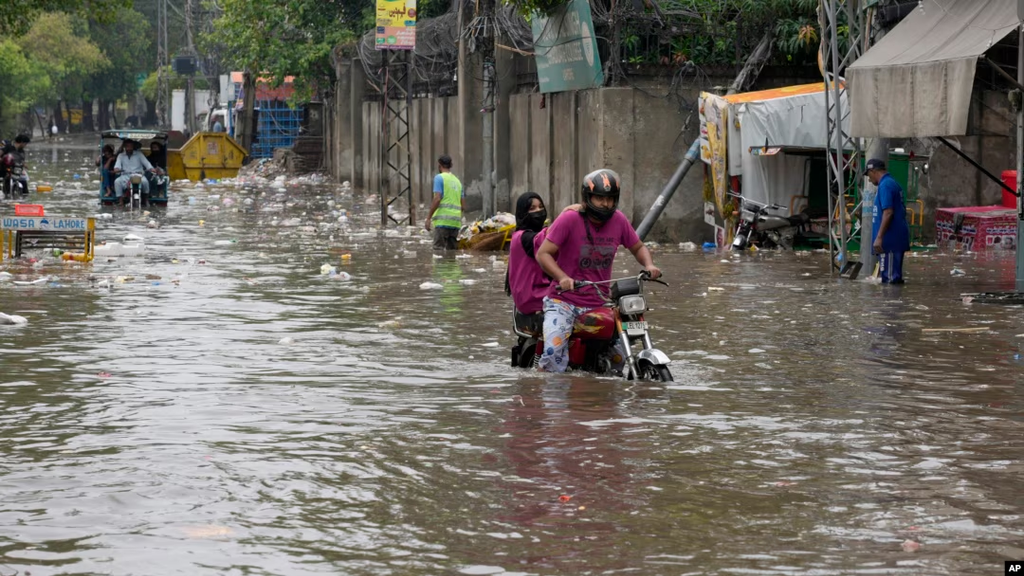
Pakistan has already seen what urban climate disruption can look like in practice. Karachi has repeatedly experienced severe waterlogging and flooding after intense monsoon rainfall, disrupting transport and economic activity in the country’s financial centre. Such events demonstrate why drainage, electricity resilience, water management, land-use planning and emergency response cannot be treated as separate municipal issues when their failures can compound during extreme weather.
The comparison with better-performing cities reinforces that point. AlphaGeo ranks Chicago among the most resilient major cities in its assessment, alongside cities including Addis Ababa, Melbourne, Barcelona, Buenos Aires, Paris and Nairobi. The report also highlights Chinese megacities including Beijing, Tianjin, Shenzhen and Shanghai for comparatively strong adaptation efficiency — demonstrating that substantial underlying climate exposure can be reduced through adaptation.
That creates an important policy distinction for Pakistan. Islamabad cannot control the amount of global greenhouse gas emissions determining future warming, nor can Karachi move away from the Arabian Sea or Multan escape its increasingly punishing heat environment. Governments can, however, influence drainage capacity, heat-action planning, electricity resilience, building standards, water systems, early-warning infrastructure and where new urban development is permitted.
Pakistan’s climate debate has traditionally been dominated by the country’s vulnerability despite its relatively small contribution to historic global emissions. That argument remains central to international climate-finance negotiations, but the AlphaGeo findings introduce another question: how effectively is Pakistan converting whatever resources it has into urban adaptation?
The answer increasingly carries economic consequences. Karachi is Pakistan’s principal commercial centre; Lahore is one of its largest industrial and service economies; Faisalabad anchors textile manufacturing; while Multan and Hyderabad are major regional economic centres. Climate resilience in these cities therefore affects far more than residents living in vulnerable neighbourhoods. Disruption can travel through factories, ports, supply chains, power systems, transport networks and ultimately national economic output.