
Beyond Reopening Hormuz, Iran-Oman Corridor Could Shift Control Over a Global Energy Chokepoint
By Shahnoor Saqib — The Changer
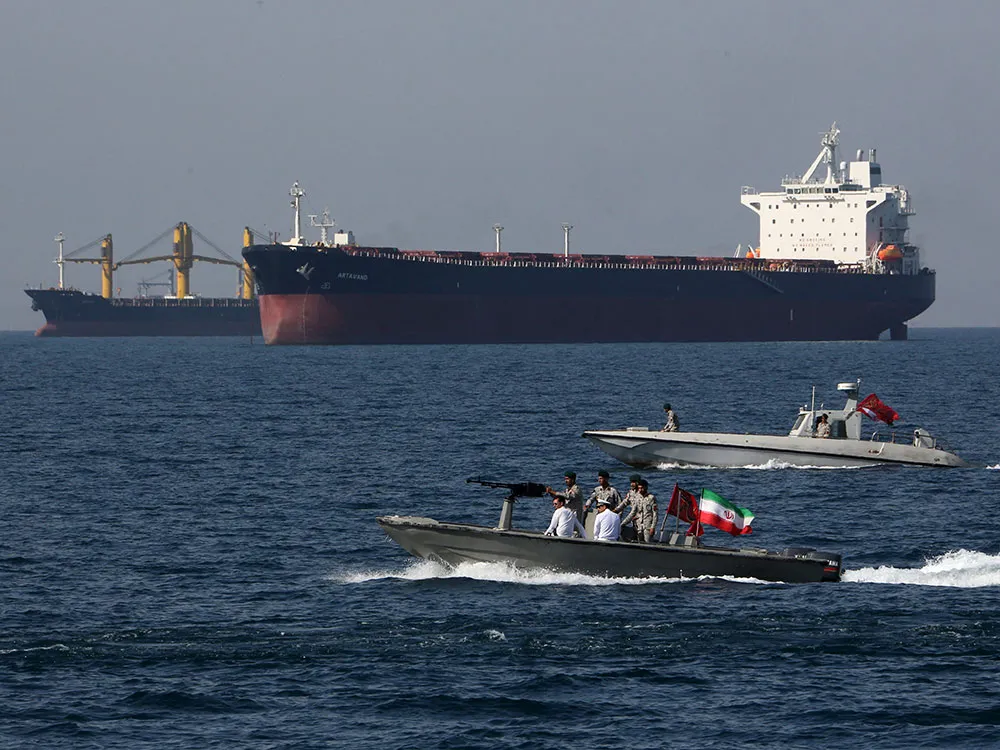
TEHRAN: Iran says a new international shipping corridor through the Strait of Hormuz will be announced in the coming days, but the emerging arrangement represents considerably more than another attempt to get commercial vessels moving through one of the world’s most important energy chokepoints. Details disclosed by Iranian officials indicate Tehran is seeking a maritime architecture in which ships would use an Iran-Oman agreed route with entry and exit points under Iranian control, while a separate restricted zone would extend beyond the strait into parts of the Gulf.
Mohsen Rezaei, secretary of Iran’s Supreme National Security Council, said Sunday that Iran and Oman would sign an agreement on the new Hormuz corridor in the coming days. He said the route’s entry and exit points would be controlled by Iran, according to reporting based on Iranian state media. Tehran had previously said Iranian and Omani specialists had agreed the geographical coordinates of a replacement route and were working through the final technical details.


The significance lies in what that could mean for navigation rather than simply whether ships begin moving again. Reuters reported in August, citing a senior Iranian source and two regional officials, that the proposed Iran-Oman arrangement would give Tehran control over ships entering the Gulf through Hormuz — potentially one of the most consequential concessions to Iran during negotiations over the waterway. Iranian officials cautioned at the time that agreement on coordinates would not itself guarantee security or amount to an unconditional reopening of the strait.
That distinction has become even more important because Tehran is now pairing the corridor announcement with a second measure. Rezaei said Iran would establish a new prohibited or restricted maritime zone outside the Strait of Hormuz, beginning from what Tehran describes as the U.S. naval blockade line and extending into areas of the Gulf. Ships entering that area with the intention of transiting Hormuz would be placed on an Iranian sanctions list, he said.
The combination potentially creates two maritime spaces operating simultaneously: an approved corridor negotiated with Oman through which Iran intends to regulate passage, and a wider zone in which Tehran says vessels attempting alternative transit could face penalties. Iran’s Revolutionary Guards had already warned vessels that routes officially designated by Tehran were the only safe passages through the strait.
Oman’s role makes the arrangement diplomatically significant. Muscat has repeatedly acted as an intermediary during regional crises, and Iran and Oman announced in August that they had agreed on a temporary route whose entry and part of its exit would pass through Iranian territorial waters. Iranian officials nevertheless stressed that the corridor agreement should not be confused with a complete reopening of Hormuz, which Tehran has linked to broader political and security conditions.
The stakes extend far beyond Iran and Oman. Before the current disruption, the Strait of Hormuz was one of the world’s most important oil-transit corridors, linking Gulf producers to markets in Asia and elsewhere. Months of confrontation have demonstrated how quickly military risk at a geographically narrow passage can affect shipping decisions, insurance calculations, tanker movements and global energy expectations.
The corridor also sits inside a widening contest between Iranian and American concepts of maritime access. Washington has maintained naval pressure around Iran while Tehran has challenged vessels attempting to use routes it does not recognise. The latest escalation included exchanges involving U.S. warships, Iranian forces and oil tankers, underscoring that commercial navigation is now entangled with the broader U.S.-Iran confrontation.
There is therefore an important caveat to Tehran’s announcement. An Iran-Oman agreement does not automatically mean international shipping companies will regard Hormuz as fully open or safe. Operators and insurers must evaluate military threats, route security and commercial risk independently, while the United States and Iran continue to dispute the rules governing passage.
What is emerging is consequently more consequential than a replacement line drawn across a maritime chart. If implemented as Tehran describes it, the new system could establish an internationally used corridor negotiated with Oman but substantially controlled by Iran — while vessels attempting to bypass that framework face a restricted zone and threatened Iranian sanctions.
The real contest over Hormuz is therefore shifting from whether the strait is open to a harder question: who gets to determine the route, conditions and security architecture under which global shipping passes through it.