
By Jahanzaib Saqib — The Changer
KYIV: A renewed American effort to end Russia’s war in Ukraine has produced something short of the breakthrough its architects are seeking but potentially broader than another unsuccessful round of ceasefire diplomacy: Kyiv and Washington are now simultaneously discussing negotiations, battlefield protection, winter energy security and the economic architecture of a post-war Ukraine.
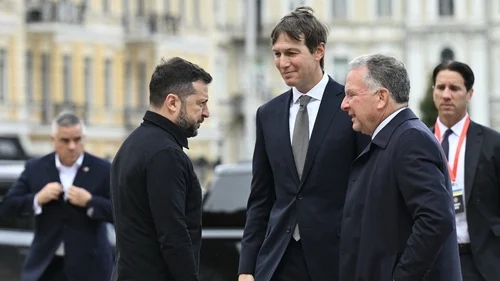
U.S. envoys Steve Witkoff and Jared Kushner met Ukrainian President Volodymyr Zelenskyy in Kyiv on Sunday, one day after holding roughly three hours of talks with Russian President Vladimir Putin in Moscow. It was the envoys’ first official visit to the Ukrainian capital during Russia’s full-scale invasion and represented the latest attempt by President Donald Trump’s administration to revive a negotiating process that has repeatedly failed to produce an agreement ending the fighting.


Zelenskyy’s assessment after the meeting illustrated the gap between renewed diplomatic activity and expectations on the ground. He said Ukraine hoped to reach agreements with its American partners but was preparing on the assumption that the war would continue into winter. No peace breakthrough was announced by either the Ukrainian president or the American delegation.
Yet the agenda in Kyiv shows that the diplomatic effort has expanded beyond trying to negotiate an immediate halt to hostilities. Zelenskyy’s office said considerable attention was devoted to a winter support package, particularly strengthening Ukraine’s air defence and energy sector. Kyiv also wants substantial supplies of U.S. liquefied natural gas, an indication that energy resilience is being treated alongside military protection as part of Ukraine’s preparations for another wartime winter.
Longer-term security and economic guarantees were discussed at the same time. Zelenskyy said Ukraine’s armed forces must remain strong as a fundamental security guarantee after the war, while the parties also discussed what he called a “prosperity plan” and economic guarantees necessary for recovery and reconstruction. That combination effectively stretches the negotiations across three different time horizons: surviving the coming winter, establishing conditions for a settlement and determining how Ukraine would be secured and rebuilt afterward.
The unresolved territorial dispute remains the hardest obstacle. Russia controls substantial areas of eastern and southern Ukraine and Moscow has demanded recognition of territorial claims Kyiv considers unacceptable. Zelenskyy reiterated that questions of territory are sufficiently complex that they ultimately need to be resolved at the leadership level, while Witkoff said compromises would be required from both sides.
The American envoys nevertheless emerged publicly optimistic. Witkoff described the Kyiv discussions as meaningful and substantive and said Washington believed the ingredients for progress existed. Kushner said the American effort was aimed at constructing a framework capable of producing a durable peace rather than simply pressing either Russia or Ukraine to accept a predetermined outcome.
The next stage could also become more multilateral. French presidential diplomatic adviser Emmanuel Bonne, British national security adviser Jonathan Powell and German foreign-policy adviser Günter Sautter joined a separate round of the Kyiv discussions. Zelenskyy said Ukraine, Europe and the United States had agreed to meet again soon, although a location has not yet been determined. American officials are also exploring the possibility of restoring a trilateral U.S.-Ukraine-Russia format.
That European presence matters because any emerging settlement would have consequences extending beyond the immediate Russia-Ukraine battlefield. Kyiv continues to depend heavily on European military and financial assistance, while European governments would likely play a major role in security guarantees, reconstruction and long-term economic support. Bringing European advisers directly into the Kyiv leg of Washington’s shuttle diplomacy therefore begins connecting an American negotiating initiative with the governments that could ultimately be required to help implement parts of a settlement.
But diplomacy continues alongside war rather than replacing it. Fighting persisted outside the capitals during the envoys’ mission, and Russia and Ukraine continued drone and missile operations despite temporary restraint involving Moscow and Kyiv during the diplomatic visits. Reuters reported that the Moscow discussions produced no visible breakthrough before Witkoff and Kushner travelled onward to Ukraine.
That is why Zelenskyy’s reference to winter may prove more consequential than another prediction about how long the conflict will last. Washington’s peace initiative is now operating on two tracks at once: trying to restart negotiations while simultaneously helping Ukraine prepare militarily and economically for the possibility that those negotiations will fail to stop the fighting before winter.
The contradiction captures the state of the diplomacy after the envoys’ Moscow-to-Kyiv mission. The negotiating architecture is expanding — potentially encompassing Russia, Ukraine, the United States and major European governments — but so is contingency planning for continued war.