
By Shahzaib Saqib — The Changer
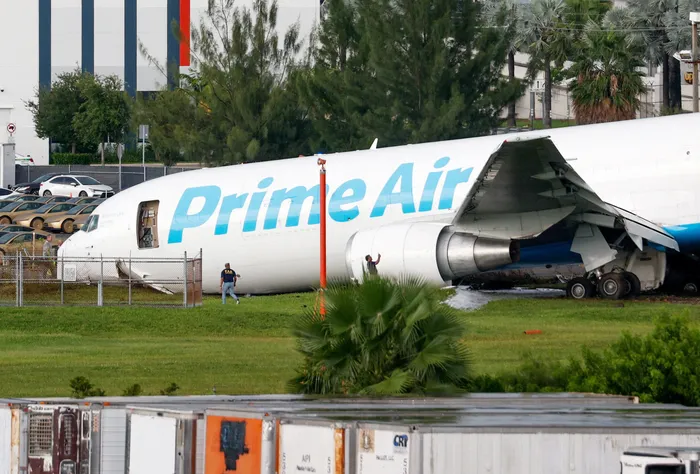
MIAMI: The deadly crash of an Amazon-branded Boeing 767 at Miami International Airport has created an immediate aviation investigation and major disruption at one of America’s busiest international gateways. But behind the Prime Air branding lies another significant dimension: the aircraft was not being flown by Amazon itself, highlighting the network of specialist airlines that operates parts of the infrastructure behind rapid e-commerce delivery.
At least five people were killed and five others injured after 21 Air Flight 7598 overran a runway while landing at Miami International Airport shortly before 2 p.m. on Sunday after arriving from San Juan, Puerto Rico. The Boeing 767-300 crossed beyond the runway, struck multiple vehicles and caught fire, according to authorities. Three of the injured were reported in critical condition.


The FAA has confirmed the essential sequence but not the cause. Its official preliminary statement says Flight 7598 overran the runway after landing and identifies the aircraft as a Boeing 767-300 cargo jet arriving from San Juan. The FAA said it would investigate, while the National Transportation Safety Board is taking part in the investigation. Until investigators establish what happened, weather, aircraft condition, crew actions or other possible factors should not be treated as causes.
The corporate structure behind the flight is particularly important. Although the aircraft carried Amazon Prime Air branding and was operating within Amazon’s logistics system, the flight was operated by North Carolina-based cargo carrier 21 Air on Amazon’s behalf. That distinction illustrates how the physical infrastructure behind an Amazon delivery can extend beyond warehouses, vans and Amazon-branded aircraft to independent aviation companies contracted to operate portions of the air network.
The aircraft itself adds another layer for investigators. The jet was approximately 32 years old and began its working life as a passenger aircraft before being converted for cargo operations in 2015, according to aircraft-history information cited by the Associated Press. Aircraft age alone does not establish whether it contributed in any way to an accident, and there is currently no official evidence connecting the jet’s age or conversion to Sunday’s runway overrun.
That distinction will be critical as scrutiny intensifies. Investigators will have to reconstruct the aircraft’s approach and touchdown, its speed and stopping performance, crew actions, runway and weather conditions, maintenance history and other evidence before reaching conclusions. The NTSB investigation rather than early speculation will determine the probable cause.
The accident also demonstrated how quickly a single cargo incident can disrupt a major passenger hub. Miami International temporarily stopped operations after the crash, with all runways and taxiways initially closed. More than 60 Miami-Dade Fire Rescue units responded as firefighters confronted flames, trapped occupants and a continuing fuel leak. By Sunday evening, two of the airport’s four runways had reopened, according to Reuters.
Flight disruption spread far beyond the wreckage. Early tracking data cited in reporting showed hundreds of delays as authorities imposed a ground stop and incoming aircraft were affected. The episode illustrates the interdependence of passenger aviation and cargo logistics at large hub airports: an accident involving one freighter can interrupt movements by airlines and passengers whose journeys have nothing to do with the cargo operator involved.
For Amazon, the consequences extend beyond immediate delivery operations. The company said it was working with authorities and described the safety and well-being of those affected as its priority. The crash will inevitably place attention on the relationship among Amazon, the contracted operator and the broader network through which Prime Air capacity is provided, although there is currently no official finding assigning responsibility for the accident to Amazon, 21 Air, Boeing or the flight crew.
There is also historical context. This is not the first fatal accident involving an aircraft operating within Amazon’s air-cargo network: a Prime Air Boeing 767 crashed near Houston in 2019. That history does not establish any connection between the accidents, and Sunday’s Miami crash must be investigated on its own evidence.
The central question therefore extends beyond the dramatic images of a burning Amazon-branded aircraft. Modern e-commerce logistics increasingly depends on complex relationships among technology companies, airports, aircraft owners, contractors and specialist cargo airlines.
The Miami investigation will determine why Flight 7598 left the runway. Its wider significance is that a disaster involving one contracted Boeing 767 has suddenly made visible part of the aviation machinery operating behind Amazon’s enormous delivery network.