
By Web Desk
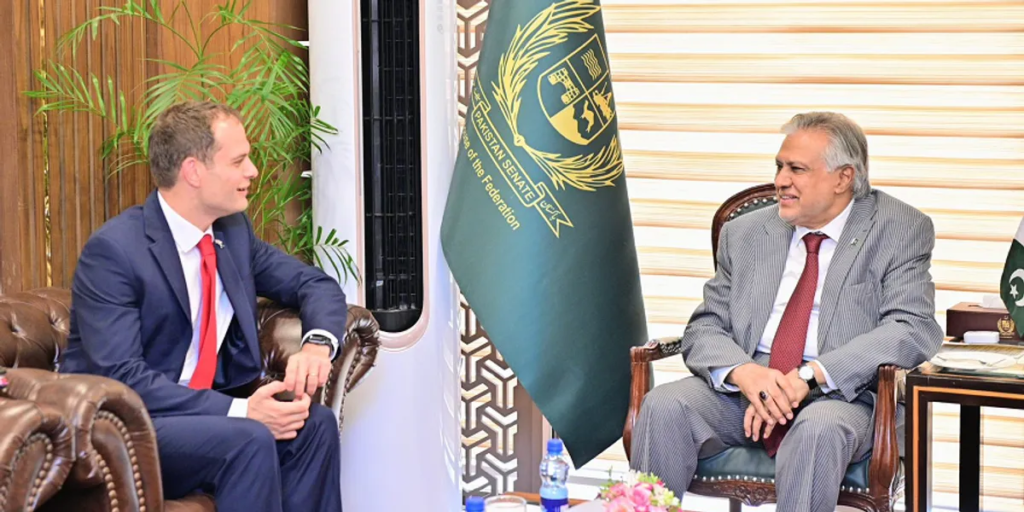
LONDON — Britain has praised Pakistan’s role in mediating between the United States and Iran, giving Islamabad fresh diplomatic recognition as it tries to preserve channels between two adversaries whose fragile peace process has repeatedly been threatened by renewed confrontation. British Foreign Secretary Ed Miliband acknowledged Pakistan’s “constructive role” and its efforts to facilitate dialogue, diplomacy and stability during talks with Deputy Prime Minister and Foreign Minister Ishaq Dar in London on Thursday.
The acknowledgement carries greater weight because Pakistan’s involvement has moved well beyond conventional appeals for restraint. Islamabad, alongside Qatar, helped broker the June agreement between Washington and Tehran and subsequently remained directly involved as a mediator in technical-level negotiations under the Islamabad Memorandum of Understanding. Those talks brought US and Iranian representatives together with Pakistani and Qatari mediators in Switzerland, giving Islamabad a formal place inside the diplomatic machinery rather than leaving it on the sidelines of the conflict.


During Thursday’s meeting, Dar briefed Miliband on Pakistan’s diplomatic and mediation efforts and the progress achieved through those engagements. The two ministers also discussed the wider Middle East crisis and agreed on sustained engagement to promote regional stability. Their talks came as Britain and Pakistan moved to establish a structured mechanism for regular dialogue between their foreign ministries covering the wider bilateral relationship.
Britain’s recognition is not new, but its repetition amid renewed US-Iran tensions is significant. Prime Minister Keir Starmer publicly congratulated Pakistan, Qatar and other mediators after the June breakthrough, while Britain’s Middle East minister travelled to Islamabad shortly afterwards and personally thanked Pakistan for its leadership in helping broker the agreement. The UK government at the time explicitly described Pakistan as one of the partners that had helped produce the US-Iran peace deal.
Pakistan’s mediation has continued even as implementation of the agreement became increasingly difficult. The Foreign Office said earlier this month that Islamabad remained engaged with the parties and distinguished between short-term crisis facilitation and the longer diplomatic process created around the Islamabad MoU. Pakistani officials have continued contacts with Tehran while trying to preserve a negotiating framework capable of bringing Washington and Iran back into substantive discussions.
The significance for Pakistan extends beyond the immediate war. Islamabad has traditionally been viewed internationally through its strategic geography, nuclear capability, relationship with China and complicated security position between South Asia, Afghanistan and the Middle East. The Iran crisis has allowed Pakistan to turn some of those same geopolitical pressures into diplomatic leverage: it maintains channels with Tehran while retaining access to Washington, close relationships with Gulf capitals and a strategic partnership with Beijing.
That diplomatic reach is becoming increasingly visible internationally. Commonwealth Secretary-General Shirley Botchwey also praised Pakistan this week after Dar briefed her in London on Islamabad’s role in brokering peace between the United States and Iran. According to Pakistan’s Foreign Ministry, Botchwey specifically credited Pakistan and Dar’s mediation efforts with helping avert a destructive war and contributing to regional stability.
The harder test, however, lies ahead. International praise does not guarantee that Pakistan can overcome the fundamental disputes separating Washington and Tehran, and Islamabad cannot control decisions made by either capital. What Pakistan has established is something more limited but strategically valuable: a recognised position inside the diplomatic process and an ability to communicate across political divides that have increasingly narrowed direct US-Iran engagement.
For Islamabad, preserving that position could become one of the more consequential foreign-policy gains to emerge from the crisis. Pakistan entered the confrontation as a country exposed to the consequences of a Middle Eastern war; it is increasingly being recognised as one of the countries trying to determine how that war ends.