
Pakistan | By Uzair Saleem
ISLAMABAD — Former prime minister Imran Khan was returned to Adiala Jail early Friday after undergoing a medical examination at the Pakistan Institute of Medical Sciences (PIMS), where a team of specialists declared him “medically fit,” Information Minister Attaullah Tarar said. The examination came after the Supreme Court ordered medical assessment and treatment for the jailed PTI founder, although the government took him to PIMS rather than Shifa International Hospital, the private facility specifically named in the court’s interim order.
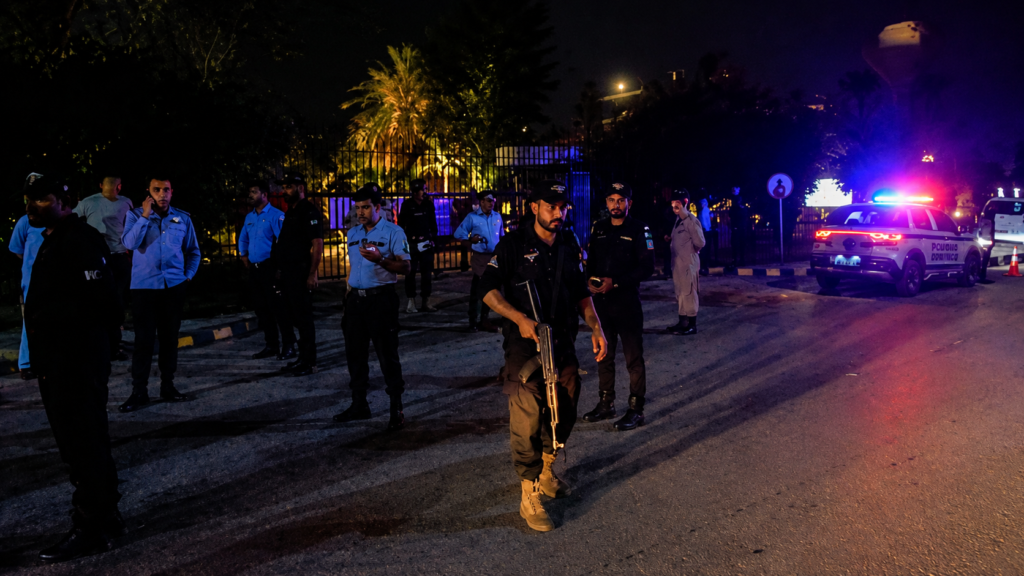
Tarar said Khan was moved from Adiala Jail during the night of August 20-21 under heightened security and examined by specialists including an ophthalmologist, cardiologist and physician. According to the minister, doctors from Shifa International Hospital were also present during the assessment and Khan’s sister, Dr Uzma Khan, remained with him throughout the medical process. After doctors found him medically fit, the former premier was taken back to Adiala Jail at around 5 a.m. on August 21.


The government said the decision to use PIMS was driven by security concerns rather than politics. Parliamentary Affairs Minister Tariq Fazal Chaudhry said security agencies decided against taking Khan to Shifa because of conditions surrounding the planned transfer, while Tarar blamed gatherings of PTI supporters along the route and outside the private hospital. PTI disputes that explanation and says it had explicitly instructed supporters not to assemble at Shifa after the Supreme Court issued its order.
The distinction between the two hospitals has become central to the controversy because the Supreme Court’s August 18 order was unusually specific. A three-member bench directed authorities to transfer Khan to Shifa International Hospital within two days and establish a multidisciplinary medical board comprising a physician, general surgeon, internal-medicine specialist, ophthalmologist and cardiologist. The court also permitted Khan’s personal physician, Dr Faisal Sultan, and Dr Uzma to remain associated with his examination and treatment and directed the government to implement its interim directions “in letter and spirit.”
Khan’s family and PTI consequently reject the government’s claim that the PIMS examination fully satisfied the court order. Dr Faisal Sultan said he had been waiting at Shifa while Khan was examined elsewhere, while Dr Uzma questioned the adequacy of the medical assessment and raised concerns about the impact of his detention conditions on his health. PTI has said it intends to pursue the issue legally and has raised the possibility of contempt proceedings.
The government has separately sought a review of the Supreme Court’s order, arguing that prison regulations govern how inmates are transferred for treatment and questioning the legal basis for directing that Khan be treated at a particular private hospital. The Supreme Court registrar initially returned the government’s review petition with objections. The underlying interim order therefore remains at the centre of the dispute as the government, PTI and Khan’s family offer sharply different interpretations of what constituted compliance.
The Changer Angle: ‘Medically Fit’ Does Not Resolve the Bigger Legal Question
The immediate government headline is straightforward: specialists examined Imran Khan and declared him medically fit to return to prison. But that finding does not settle the larger controversy created by the overnight transfer. The Supreme Court did not simply order authorities to obtain a medical opinion somewhere; it specifically named Shifa International Hospital, prescribed the composition of the medical board, included Khan’s personal physician in the process and required compliance with its directions “in letter and spirit.”
That creates two separate questions that should not be confused. The medical question is whether Khan currently requires hospitalisation; according to the government and the PIMS examination, he does not. The legal question is whether security agencies could substitute PIMS for the court-designated Shifa facility without first obtaining permission from the Supreme Court. The medical finding does not automatically answer the second question.
That distinction could now drive the next stage of the case. If PTI seeks contempt proceedings, the Supreme Court may have to decide whether the security circumstances justified the government’s deviation from its directions. The court could also clarify whether the PIMS examination fulfilled the substantive purpose of its order or whether Khan must still undergo the Shifa-based assessment originally prescribed.
The story therefore did not end when Khan returned through the gates of Adiala Jail at 5 a.m. His immediate hospital stay may be over, but the dispute over whether the executive complied with Pakistan’s highest court has only intensified.