
Pakistan | By Jahanzaib Saqib
ISLAMABAD — Pakistan Tehreek-e-Insaf accused the federal government on Friday of violating a Supreme Court order governing former prime minister Imran Khan’s medical examination, after authorities took the jailed opposition leader to the state-run Pakistan Institute of Medical Sciences rather than the private Shifa International Hospital specified by the court. PTI Chairman Barrister Gohar Ali Khan said the party would pursue the matter legally, while Khan’s family questioned whether the brief overnight examination adequately addressed the health concerns that prompted the Supreme Court’s intervention.
The Supreme Court had ordered on August 18 that Khan be shifted from Adiala Jail to Shifa International Hospital within two days for examination by a medical board that was to include specialists as well as one of his personal physicians. Instead, Information Minister Attaullah Tarar said Khan was taken to PIMS, where doctors conducted a detailed examination and declared him medically fit before he was returned to Adiala Jail early Friday. The government cited security concerns surrounding Shifa, where PTI supporters had gathered, as the reason for changing the hospital.


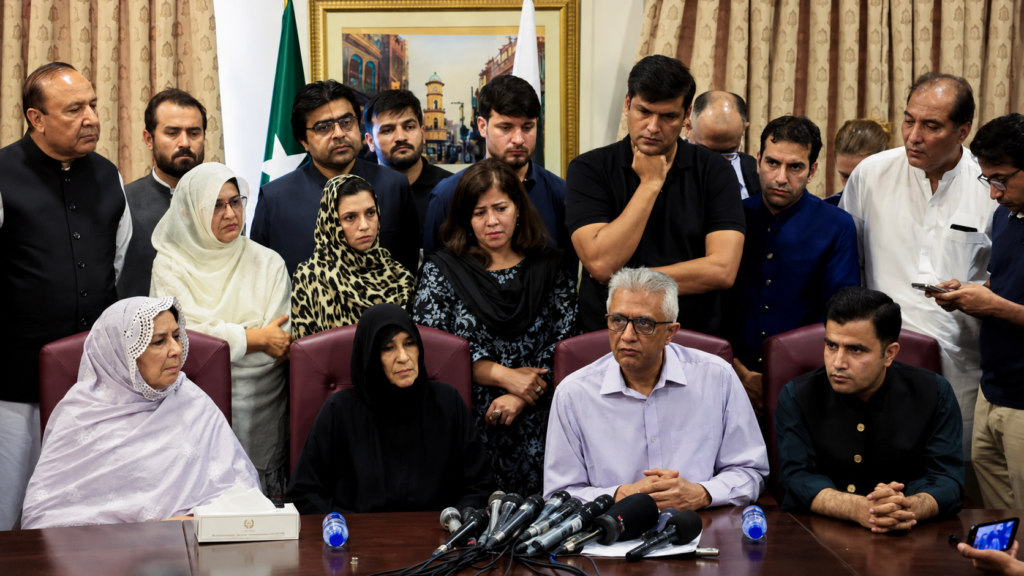
Khan’s sister, Dr Uzma Khan, who met him during the medical process, disputed the government’s portrayal of the examination and said her brother had raised concerns about the effect of his prison conditions on his health. She said Khan complained that prolonged isolation was affecting him physically and mentally and maintained that his medical assessment had not been sufficiently thorough. Khan’s personal physician, Dr Faisal Sultan, had been waiting at Shifa International Hospital but was told later that Khan had already been returned to prison.
The government maintains that Khan received an appropriate medical assessment and that doctors found no urgent condition requiring hospitalisation. Tarar said specialists examined the former premier and declared him fit to remain in prison. The dispute therefore centres not simply on Khan’s medical condition but on whether the government was entitled to alter arrangements that had been specifically set out by the country’s highest court.
PTI says it is considering contempt proceedings over what it regards as non-compliance with the Supreme Court directive. The government, meanwhile, has already challenged the underlying order, arguing in a review petition that prison regulations ordinarily place decisions over an inmate’s medical treatment within the administrative system and that directing treatment at a particular private hospital raises broader legal questions. The existence of that challenge, however, is separate from whether the August 18 order remained binding while the review was pending.
The Changer Angle: The Dispute Has Shifted From Khan’s Health to Compliance With the Court
The critical question now is unusually precise: did security concerns permit the executive to substitute PIMS for Shifa when the Supreme Court had expressly named Shifa International Hospital and prescribed the composition of the medical board? That question could become more consequential than competing political claims about Khan’s health because it directly concerns compliance with a Supreme Court order.
There is also an important distinction between the government’s two legal positions. Islamabad is entitled to ask the Supreme Court to review or modify its ruling; whether officials could effectively modify its implementation themselves before receiving relief from the court is a different matter. If PTI proceeds with contempt litigation, the government may have to explain both the security assessment that led to the change and the legal authority under which that decision was made.
That makes the next phase less about whether PTI or the government wins the political argument and more about what the Supreme Court itself says its order required. If the court accepts the government’s security justification, Islamabad’s position will strengthen. If it finds that the explicit direction to use Shifa was disregarded without prior judicial approval, the controversy could become a test of executive compliance with Pakistan’s highest court.