
Pakistan | By Shahnoor Saqib
ISLAMABAD — Pakistan marked its 79th Independence Day on Friday with nationwide celebrations, flag-hoisting ceremonies and military salutes as the country’s leadership called for national unity, economic progress and peace while reaffirming its resolve to defend the country against any external threat.
The day began with a 31-gun salute in Islamabad and 21-gun salutes in the provincial capitals. Special prayers were offered for Pakistan’s peace, solidarity and prosperity, while government buildings, streets and public spaces across the country were illuminated in green and white.


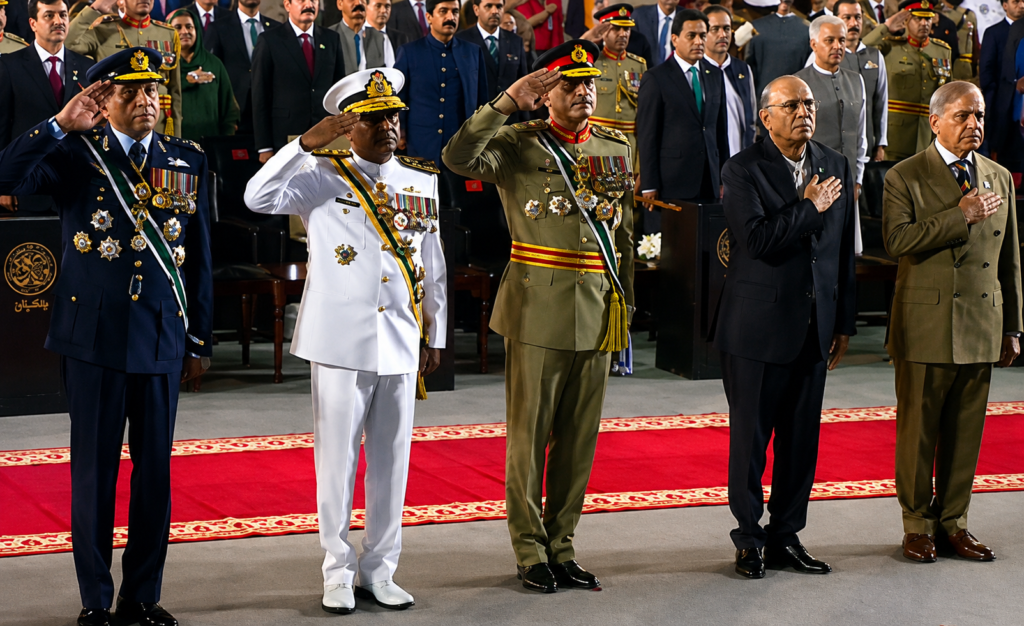
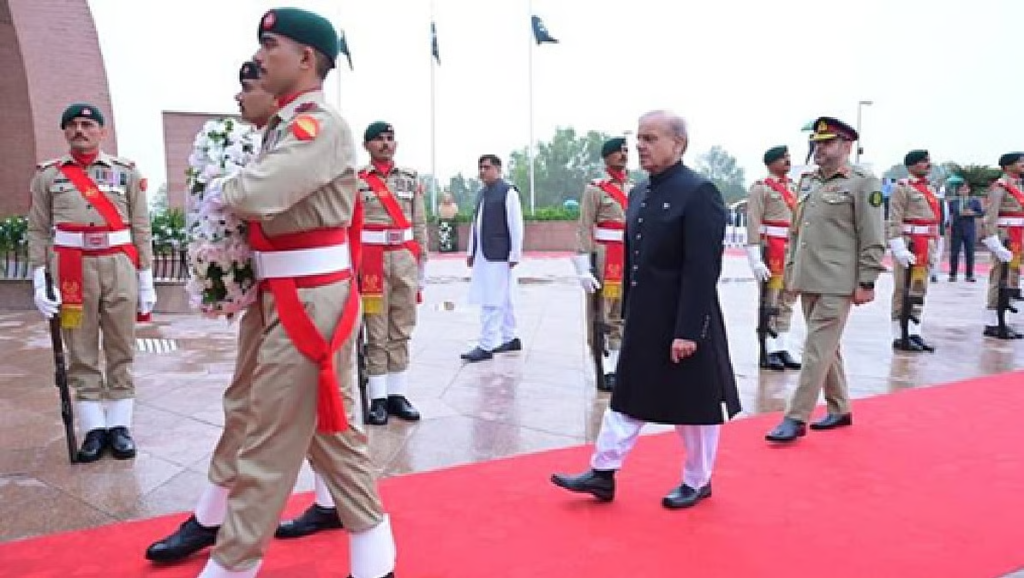
The celebrations carried additional political and military significance this year following the inauguration of Yadgar-e-Fatah in Islamabad on the eve of Independence Day.
President Asif Ali Zardari, Prime Minister Shehbaz Sharif and Chief of Defence Forces and Army Chief Field Marshal Syed Asim Munir jointly inaugurated the monument, built to commemorate the country’s martyrs and the 2025 Marka-e-Haq conflict with India.
Shehbaz Calls for Peace but Warns Against Aggression
Addressing the Yadgar-e-Fatah ceremony, Shehbaz said Pakistan wanted peace and stability in the region but warned that the country’s restraint should not be interpreted as weakness.
The prime minister described Pakistan’s water interests as a “red line” and warned India that Islamabad would respond if its vital interests were threatened.
His remarks combined a message of deterrence with an emphasis on diplomacy.
Shehbaz pointed to Pakistan’s role in mediation between the United States and Iran and said Islamabad wanted the world protected from further conflicts. He also highlighted Pakistan’s developing defence partnership with Saudi Arabia and Türkiye as part of the country’s broader regional engagement.
Zardari Remembers Sacrifices Behind Independence
President Zardari used his Independence Day message to remember the sacrifices that led to Pakistan’s creation and urged citizens to protect the principles on which the country was founded.
He also praised the country’s civilian and military leadership for advancing Pakistan’s national interests and strengthening relations with other Muslim countries.
The president was scheduled to lead the main national flag-hoisting ceremony in the federal capital, with similar ceremonies taking place at provincial, divisional and district headquarters.
Armed Forces Mark Independence Day
Pakistan’s military leadership also congratulated the nation.
Field Marshal Munir, Chief of Naval Staff Admiral Naveed Ashraf and Chief of Air Staff Air Chief Marshal Zaheer Ahmed Baber Sidhu issued Independence Day messages reaffirming the armed forces’ commitment to the country’s sovereignty and security.
The military’s media wing also released the national song “Mera Pyara Watan Pakistan” to mark the occasion, emphasizing national unity and attachment to the country.
Celebrations Across Pakistan
Independence Day events extended well beyond Islamabad.
National flags covered streets, markets and public buildings as cultural programs, exhibitions, seminars and public celebrations were organized across the country. Fireworks illuminated Islamabad around midnight as the country formally entered August 14.
Celebrations were also held across Azad Jammu and Kashmir, where the day began with a 21-gun salute in Muzaffarabad and prayers for peace and prosperity.
From Military Resolve to an Economic Challenge
Beyond the ceremonies, Pakistan’s leadership increasingly framed the next national challenge in economic terms.
Planning Minister Ahsan Iqbal urged Pakistanis to approach what he called the country’s “economic battle” with the same unity and resolve demonstrated during recent national-security challenges.
That message reflects the broader challenge confronting Islamabad: translating national solidarity into economic growth, jobs, investment and opportunities for a young population.
Why It Matters
Pakistan’s 79th Independence Day arrives at a consequential moment.
The country is projecting greater confidence in its regional diplomacy and defence posture while simultaneously confronting difficult economic and security challenges at home.
The inauguration of Yadgar-e-Fatah gave this year’s celebrations a particularly strong national-security dimension. But the leadership’s messages also repeatedly returned to unity, economic development and peace.
Nearly eight decades after independence, those priorities increasingly define Pakistan’s next test: not simply defending the state, but building the economic and institutional strength needed to shape its future.